Government decree was adopted to reconstruct mosques and cemeteries
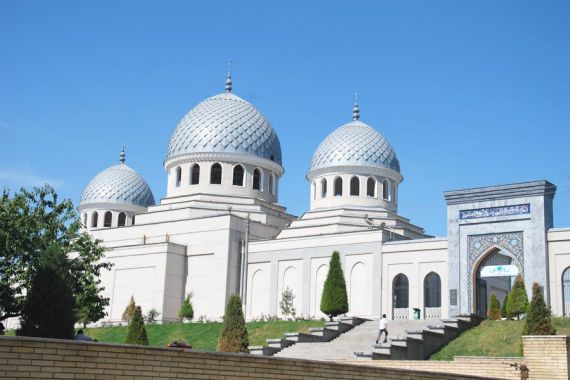
Ministry of Justice announced on its “Legal info” channel about government’s decree on reconstruction of mosques, cemeteries and shrines.
According to the decree special places would be built to carry out funeral ceremonies. In order to reconstruct shrines, mosques and cemeteries 3 bln soums is to be allocated to regional budgets.
The list of mosques that are supposed to be reconstructed is going to be made and reconstruction works would be funded by Charity Fund on preservation of shrines under Muslim Board of Uzbekistan and other sponsors.
The enlightenment education of youth on preservation of shrines would be executed by special events and seminars.
Press Service,
Muslim Board of Uzbekistan
“Arab Tourist”: Cities of Uzbekistan have historically been associated with trade routes known as the Silk Road

Tourism publication “Arab Tourist” has published an article dedicated to Uzbekistan, a unique country located in the heart of Central Asia and closely associated with the rich heritage of the Silk Road, reports Dunyo IA.
Publication highlights an interesting geographical feature: as a landlocked republic, Uzbekistan, together with Liechtenstein, is one of only two countries in the world that are completely surrounded by countries that are also landlocked.
Publication pays particular attention to the historical significance of the ancient cities along the Silk Road, which connected China with Central Asia, the Middle East and Europe. Samarkand, with its famous Registan Square, Bukhara, with its numerous mosques and madrasas and Khiva, with the ancient architectural complex of Itchan Kala, are presented as key centres of trade, science and Islamic civilisation, whose rich cultural heritage attracts travellers from around the world.
Article also describes the country’s unique natural and geographical diversity, ranging from the vast areas of the Kyzylkum Desert and the mountain ranges of the Tien Shan and Pamir-Alay to the fertile Fergana Valley. It highlights the important role of agriculture, specialising in the cultivation of cotton, grains, fruits and vegetables, and also addresses the region’s environmental challenges, including the fate of the Aral Sea.
“Arab Tourist” publication emphasises that modern Uzbek cities such as Tashkent, Samarkand, Bukhara, Khiva, Namangan and Andijan seamlessly combine the functions of administrative, economic and tourism centres, while carefully preserving the legacy of great historical figures in science, including the outstanding astronomer and mathematician Ulugh Beg.

- «
- »