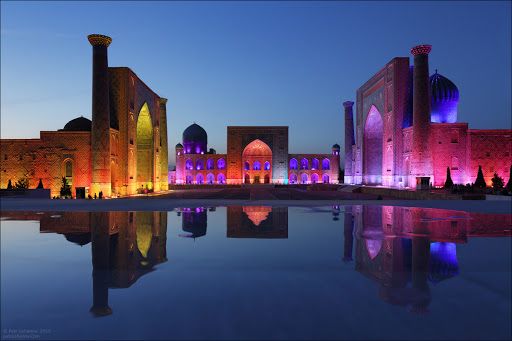
All the famous ancient places to visit in Uzbekistan What comes to mind when Uzbekistan's tourist attractions are in question? First of all, it is the country's architectural heritage, richest in Central Asia: masterpieces of medieval Islamic architecture - minarets, mosques, madrasahs (Islamic colleges), mausoleums, fortresses, palaces, etc as well as ancient Zoroastrian and Buddhist temples and ruins of ancient settlements... Among all of them stand out the famous Registan Square in Samarkand, with the three marvelous madrasahs built in the XV-XVII centuries at its three sides, and the grand Gur-e Amir Mausoleum where the great conqueror Tamerlane (Timur ) is buried. Bukhara is first of all associated with Ismail Samani Mausoleum dating back to the 9th century and the 50-meter-tall Kalyan Minaret. (There are over 170 important architectural monuments altogether in the city.) Khiva is famous for its unique Ichan-Kala 'inner city' historic part - a walled medieval Central Asian town being preserved as it was in the past - an artifact town.. . Thanks to its vast territory and very diverse terrains, Uzbekistan also boasts numerous natural attractions. They are the impressive tracts of the Kyzylkum Desert, for instance, and of course the majestic Tien Shan Mountains with their resorts and fascinating landscapes. SIGHTSEEINGS OF TASHKENT Tashkent ('a stone city'; also spelled Toshkent), Uzbekistan's capital, is in all respects a Central Asian regional hub; it is the fourth largest CIS city with a population of around 3 million. Today it has all the features of a modern metropolis and a capital, with a lot of attractive Central Asian-style newly-built structures and sites, as well as Soviet-era buildings. Tashkent is rich in museums, theaters and concert halls; there are a lot of traditional Central Asian and European-like restaurants and clubs, and several very nice parks, including a zoo and a huge botanical garden. Tashkent is the only Central Asian city which has an underground railway system (Tashkent Metro). It is probably one of the world's most beautiful: its stations are real works of art, each featuring unique designs covering various themes, such as famous people, events, valued notions, terms or just common nouns. Tashkent is a city of wide streets and numerous avenues, and is abundant in trees; although it is located in Central Asia, it has recently had a lot of evergreens planted, in addition to its traditional planes, poplars, oaks, willows, etc. Tashkent looks modern - it grew to its present size mainly during the Soviet times - but it is over 2,000 years old, and there is still some of its old part surviving, called Old City or Old Town. Tashkent Old city features a huge traditional Central Asian bazaar (there are many large and small bazaars in the city; most farmer products in the city are sold through them, not through stores), as well as several Islamic architectural monuments and quaint adobe mahalla neighborhoods , quite worth visiting for their charm. The Independence Square in Tashkent Khazrati Imam Mausolesm of Abubakr Kaftal Ash-Shashi Architectural Complex view all Tashkent Sightseeings »» SIGHTSEEINGS OF SAMARKAND Samarkand (also Samarqand) famous Uzbekistan's historc city. Over 2750 years of age, it boasts very spelled is probably the most
Prepeared by Imam Bukhari Tashkent Islamic Institute , Department of languages , English teacher Kadirov Farrukh
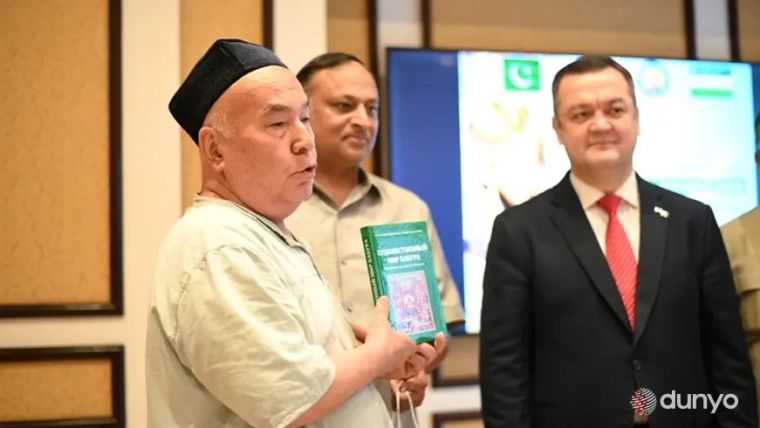
On the initiative of the Embassy of Uzbekistan in Pakistan, jointly with the Babur International Public Foundation, a visit of a delegation of Uzbek historians and Babur scholars took place, reports Dunyo IA.
Purpose of the trip is to study the historical and cultural heritage of Babur and the Baburids, historical sources, manuscripts, exhibits and artifacts preserved in Pakistan, as well as to develop scientific and cultural cooperation between the institutions of the two countries.
In Lahore, the delegation visited the Lahore Museum, Islamic Gallery, research institutions and historical monuments of the Baburid era. Issues of scientific and academic cooperation were discussed with the leadership of the University of the Punjab. Jointly with the Baburid Heritage Center at the university, a scientific and practical conference dedicated to the 500th anniversary of the Baburid dynasty was held.
In Islamabad, the Uzbek scholars visited the National Language Promotion Department of Pakistan, Quaid-i-Azam University, Allama Iqbal Open University, National Library of Pakistan and a number of scientific institutions, where they familiarized themselves with manuscripts, exhibits of the Baburid era, and other historical sources.
Delegation was also received by the Coordinator General of the OIC Standing Committee on Scientific and Technological Cooperation (COMSTECH), Muhammad Iqbal Choudhary.
The sides discussed deepening the study and preservation of the Baburid heritage, as well as its popularization within scientific circles and among the general public. An agreement was reached to hold a representative international scientific and practical conference.
The main event of the visit was the conference titled “Zahiriddin Muhammad Babur: Shared Civilizational Heritage and a Bridge of Uzbek-Pakistani Relations”.
Conference was attended by Farah Naz Akbar, Parliamentary Secretary for the Ministry of National Heritage and Culture of Pakistan; Alisher Tukhtaev, Ambassador of Uzbekistan; Ramzan Mughal, Head of the Babur Forum in Pakistan; as well as historians, Babur scholars and young researchers.
Participants emphasized the importance of the joint study of the historical and cultural heritage of Babur and the Baburids and the development of scientific ties between Uzbekistan and Pakistan.
As part of the further program of the delegation, research on a number of historical monuments of the Baburid era in the Punjab province is scheduled.