The site is working in test mode!
22 August, 2026   |   9 Rabī‘ al-awwal, 1448

Tashkent city
Fajr
04:13
Sunrise
05:39
Dhuhr
12:26
Asr
17:13
Maghrib
19:16
Isha
20:38
Bismillah
22 August, 2026, 9 Rabī‘ al-awwal, 1448

Cambridge University has opened doors for researches from Uzbekistan

08.03.2018   46983   2 min.
Cambridge University has opened doors for researches from Uzbekistan

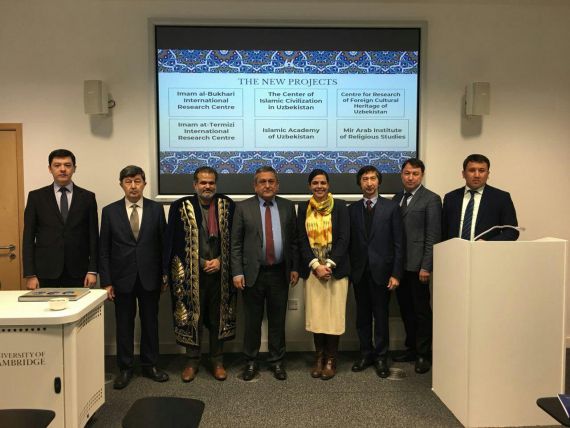
As it was informed earlier, a group of scholars on Islamic and oriental studies have visited Oxford and later Cambridge University. They met with professors and discussed future research perspectives. 

Partnership agreements between Central Asian Forum of Cambridge University and Center for Islamic Civilization, Imam Buhari scientific-research center, The Center for research on Uzbek cultural heritage abroad and Tashkent Islamic University were signed. 

According to the agreement scholars from Cambridge University are expected to provide lectures at Islamic Academy of Uzbekistan and Tashkent Islamic University and participate in international conferences. Scientific articles of Uzbek researches are going to be published in Cambridge magazines.

The sides agreed on establishing Khorazmi and Ibn Sina scholarships. Cambridge University expressed its willingness to cooperate in scientific and family tourism.

Dr. Siddharth Saxena highly evaluated positive developments in the sphere of ancient cultural heritage research. He also noted that British Oxford and Cambridge University buildings were constructed similar to the architectural styles of madrasahs in Bukhara and Samarkand whic once again proves that friendship relationships were established centuries ago. 

We greatly benefit from scientific cooperation with scientists from Uzbekistan as there is great need at our university for specialists who work on cataloging manuscripts in Turkish and Farsi.  

It should be noted with great applause that Uzbek lessons started to be offered at Cambridge University since February 12th, 2018. According to the agreements specialists visiting Cambridge from Uzbekistan would be providing Uzbek lessons.

At the end of the meetings the sides expressed their gratitude to the leaders of both countries for the friendly mutual relationships in all spheres of life including science.


Press Service,

Muslim Board of Uzbekistan

Other posts
News

“Arab Tourist”: Cities of Uzbekistan have historically been associated with trade routes known as the Silk Road

20.08.2026   30498   2 min.
“Arab Tourist”: Cities of Uzbekistan have historically been associated with trade routes known as the Silk Road

Tourism publication “Arab Tourist” has published an article dedicated to Uzbekistan, a unique country located in the heart of Central Asia and closely associated with the rich heritage of the Silk Road, reports Dunyo IA.

Publication highlights an interesting geographical feature: as a landlocked republic, Uzbekistan, together with Liechtenstein, is one of only two countries in the world that are completely surrounded by countries that are also landlocked.

Publication pays particular attention to the historical significance of the ancient cities along the Silk Road, which connected China with Central Asia, the Middle East and Europe. Samarkand, with its famous Registan Square, Bukhara, with its numerous mosques and madrasas and Khiva, with the ancient architectural complex of Itchan Kala, are presented as key centres of trade, science and Islamic civilisation, whose rich cultural heritage attracts travellers from around the world.

Article also describes the country’s unique natural and geographical diversity, ranging from the vast areas of the Kyzylkum Desert and the mountain ranges of the Tien Shan and Pamir-Alay to the fertile Fergana Valley. It highlights the important role of agriculture, specialising in the cultivation of cotton, grains, fruits and vegetables, and also addresses the region’s environmental challenges, including the fate of the Aral Sea.

“Arab Tourist” publication emphasises that modern Uzbek cities such as Tashkent, Samarkand, Bukhara, Khiva, Namangan and Andijan seamlessly combine the functions of administrative, economic and tourism centres, while carefully preserving the legacy of great historical figures in science, including the outstanding astronomer and mathematician Ulugh Beg.