The site is working in test mode!
20 July, 2026   |   6 Ṣafar, 1448

Tashkent city
Fajr
03:28
Sunrise
05:02
Dhuhr
12:34
Asr
17:38
Maghrib
19:56
Isha
21:27
Bismillah
20 July, 2026, 6 Ṣafar, 1448

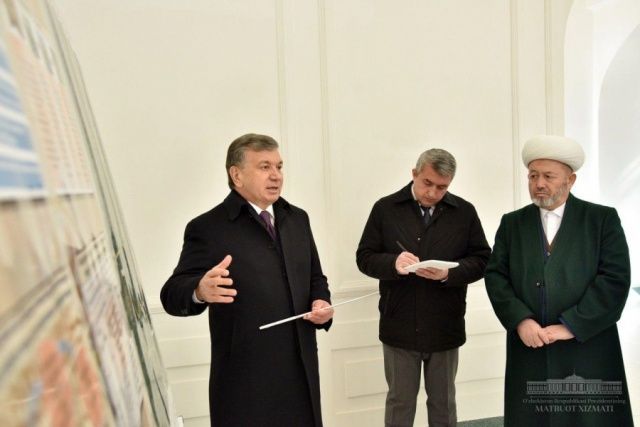
Shavkat Mirziyoyev visits the mausoleum of Bahauddin Naqshband

19.02.2018   34910   3 min.
Shavkat Mirziyoyev visits the mausoleum of Bahauddin Naqshband

The President of Uzbekistan had visited this complex on March 10, 2017, gave appropriate instructions on its further improvement, creating necessary conditions for pilgrims. 

The President inspected activities that have been implemented over the past period. 

According to tradition, surahs from the Quran were read. 

A consistent work is being carried out in accordance with the decree of President Shavkat Mirziyoyev on preparation for the 915th anniversary of Abdulhalik Gijduvani’s birth and the 700th anniversary of Bahauddin Naqshband’s birth of July 11, 2017. The Head of the state was provided with information on the “road map” of spiritual-enlightenment, scientific-practical events in connection with these anniversaries.

 
Shavkat Mirziyoyev visits the mausoleum of Bahauddin Naqshband 

It is planned to hold events on “Naqshbandi readings” for pilgrims, a scientific practical conference for university students, and a scientific conference for students of religious education institutions of the country on “High human qualities in teachings of Khojagon-Naqshbandiyya”. In addition, it is planned to organize an international scientific and practical conference on “Seven spiritual guides of Bukhara: renaissance value of Sufi teaching of Central Asia for the Islamic civilization”. 

The President of the country noted the need of conducting these events at a high organizational level. 

The last resting places of seven spiritual guides – Bahauddin Naqshband, Abdulhalik Gijduvani, Arif Revgari, Ali Romitani, Babai Samosi, Anjir Fagnavi, Said Amir Kulal are revered not only by people of Uzbekistan, but also by Muslims all over the world. 

The Head of the state was informed about the plans on reconstruction of these complexes and opening of new tourist routes. Therefore, it is planned to restore the mausoleums, landscape their territories, build hotels, teahouses, shopping complexes and parking lots. 

The distance between these complexes is 122 kilometers. Shavkat Mirziyoyev gave instructions on organizing a modern infrastructure along the roads linking the mausoleums. In addition, the need was noted for organizing a special faculty on studying the history of Bukhara in Bukhara State University. 

Along the roads linking the mausoleums of seven spiritual guides, it is necessary to establish stands with information about their lives and activities, for pilgrims. To do this, it is necessary to pay attention to training personnel, emphasized the President. 

The Head of the state considered each of the submitted projects, gave instructions on their development. 


Abu Bakir Urozov, UzA
Articles
Other posts
News

“Al-Ahram Weekly”: Uzbekistan reclaims its status as a global cultural hub

14.07.2026   26021   3 min.
 “Al-Ahram Weekly”: Uzbekistan reclaims its status as a global cultural hub

Egyptian publication “Al-Ahram Weekly” has published an article titled “Uzbekistan’s cultural renaissance: How the Silk Road Civilization is reclaiming its voice on the global stage”, highlights the country's cultural revival, the development of the creative economy and the expansion of international cultural cooperation, reports Dunyo IA.

Publication notes that for centuries, Uzbekistan sat at the very heart of the Great Silk Road, connecting the civilizations, religions and cultures of Asia, the Middle East and Europe and today, it is once again capturing the attention of the global community.

According to Gayane Umerova, Head of the Department of Creative Economy and Tourism of the Administration of the President of Uzbekistan, under the initiative of President Shavkat Mirziyoyev, culture, tourism and the creative economy are envisioned as fundamental pillars of the nation’s future, alongside infrastructure and industry. This approach, as noted, defines the state mandate to open Uzbekistan to the world and to welcome the world back to Uzbekistan.

Publication highlights that the nation's strategy extends beyond restoring historical sites to establishing new cultural platforms, including the Bukhara Biennial, the Center for Contemporary Art in Tashkent, the future Jadid Heritage Museum and international exhibition participation. This approach signifies a multifaceted cultural development policy.

Publication separately underscores the development of the creative economy and its nexus with cultural diplomacy and the nation’s investment attractiveness. It notes that every major cultural initiative in Uzbekistan is originally designed with a strategic focus on tourism development and investment attraction, including the “Samarkand Express” project, implemented in partnership with the Italian company “Arsenale Group”.

Publication also highlights the international acclaim received by Uzbekistan’s cultural projects, including the nation’s “Garden of Knowledge” pavilion at “Expo 2025 Osaka”, which was honored with the prestigious “Red Dot: Best of the Best” award.

Particular emphasis is placed on the preservation of Uzbekistan’s Islamic heritage, the advancement of museum infrastructure and the implementation of projects aimed at integrating historical legacy into the contemporary cultural context, including the Bukhara master development plan designed by the “Wilmotte & Associés” architectural bureau.

A dedicated section of the article focuses on Uzbekistan’s cultural cooperation with Egypt and the Arab world. It notes that the sides are discussing prospects for interaction in the fields of museum management, tourism, and cultural heritage preservation, alongside the development of institutional partnerships.

According to the publication, a highly symbolic milestone was the election of Professor Khaled El-Anany as Director-General of UNESCO during the 43rd session of the organization’s General Conference, which took place in Samarkand.

In conclusion, it underscores that Uzbekistan is envisioned as a nation that remains profoundly loyal to its traditions while simultaneously advancing modern cultural and creative industries, thereby strengthening international cultural cooperation.