The site is working in test mode!
24 July, 2026   |   10 Ṣafar, 1448

Tashkent city
Fajr
03:33
Sunrise
05:05
Dhuhr
12:35
Asr
17:37
Maghrib
19:52
Isha
21:22
Bismillah
24 July, 2026, 10 Ṣafar, 1448

Shavkat Mirziyoyev visits the mausoleum of Bahauddin Naqshband

19.02.2018   35083   3 min.
Shavkat Mirziyoyev visits the mausoleum of Bahauddin Naqshband

The President of Uzbekistan had visited this complex on March 10, 2017, gave appropriate instructions on its further improvement, creating necessary conditions for pilgrims. 

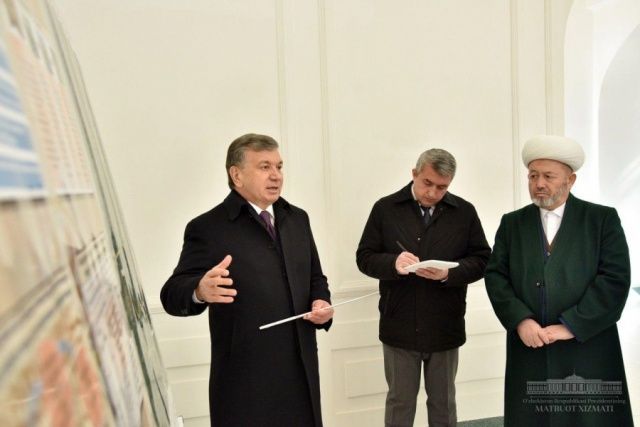
The President inspected activities that have been implemented over the past period. 

According to tradition, surahs from the Quran were read. 

A consistent work is being carried out in accordance with the decree of President Shavkat Mirziyoyev on preparation for the 915th anniversary of Abdulhalik Gijduvani’s birth and the 700th anniversary of Bahauddin Naqshband’s birth of July 11, 2017. The Head of the state was provided with information on the “road map” of spiritual-enlightenment, scientific-practical events in connection with these anniversaries.

 
Shavkat Mirziyoyev visits the mausoleum of Bahauddin Naqshband 

It is planned to hold events on “Naqshbandi readings” for pilgrims, a scientific practical conference for university students, and a scientific conference for students of religious education institutions of the country on “High human qualities in teachings of Khojagon-Naqshbandiyya”. In addition, it is planned to organize an international scientific and practical conference on “Seven spiritual guides of Bukhara: renaissance value of Sufi teaching of Central Asia for the Islamic civilization”. 

The President of the country noted the need of conducting these events at a high organizational level. 

The last resting places of seven spiritual guides – Bahauddin Naqshband, Abdulhalik Gijduvani, Arif Revgari, Ali Romitani, Babai Samosi, Anjir Fagnavi, Said Amir Kulal are revered not only by people of Uzbekistan, but also by Muslims all over the world. 

The Head of the state was informed about the plans on reconstruction of these complexes and opening of new tourist routes. Therefore, it is planned to restore the mausoleums, landscape their territories, build hotels, teahouses, shopping complexes and parking lots. 

The distance between these complexes is 122 kilometers. Shavkat Mirziyoyev gave instructions on organizing a modern infrastructure along the roads linking the mausoleums. In addition, the need was noted for organizing a special faculty on studying the history of Bukhara in Bukhara State University. 

Along the roads linking the mausoleums of seven spiritual guides, it is necessary to establish stands with information about their lives and activities, for pilgrims. To do this, it is necessary to pay attention to training personnel, emphasized the President. 

The Head of the state considered each of the submitted projects, gave instructions on their development. 



Abu Bakir Urozov, UzA
Articles
Other posts
News

“Russia News”: Final Declaration of the Forum adopted in Tashkent will serve to restore the Heritage of Islamic Civilization

16.07.2026   33940   2 min.
 “Russia News”: Final Declaration of the Forum adopted in Tashkent will serve to restore the Heritage of Islamic Civilization

Russian online publication “Russia News” has published an article titled “Declaration of the Islamic Civilization Forum adopted in Tashkent - What is written in it and why is it important?”, reports Dunyo IA.

Publication states that following the 1st International Forum of Islamic Civilization “The Path of Peace, tolerance and enlightenment”, a Declaration was adopted, which outlines a number of concrete initiatives for the revival and promotion of the humanistic heritage of Islamic civilization.

It is noted that the starting point of the Declaration is the initiative of the President of Uzbekistan, Shavkat Mirziyoyev, voiced back in 2017 from the rostrum of the UN General Assembly. At that time, he proposed to engage in the revival and promotion of the humanistic heritage of Islamic civilization. This resulted in the creation of the Center of Islamic Civilization in Uzbekistan and ultimately, the forum itself.

Document was signed by representatives from more than 40 countries. At its core is a simple but important idea: Islamic civilization has made a tremendous contribution to global science, culture, and education, and this contribution is undeservedly underestimated. This is especially true against the backdrop of the fact that Islamophobia, xenophobia and simply distorted perceptions of Islam remain prevalent in the world.

Publication also notes a number of initiatives aimed at preserving and popularizing the Islamic civilizational heritage. Among them are the creation of the World Alliance of Islamic Civilization, digital platforms and libraries, international research programs, awards, funds, an encyclopaedia, as well as platforms for cooperation among scholars, museums, and youth. All proposals have been submitted to the International Council of the Forum for the development of a roadmap for their implementation until 2030.

In conclusion, the publication notes that the Declaration is viewed not as a finality, but as a starting point for further implementation.