The site is working in test mode!
12 September, 2026   |   1 Rabī‘ ath-thānī, 1448

Tashkent city
Fajr
04:40
Sunrise
06:00
Dhuhr
12:19
Asr
16:47
Maghrib
18:42
Isha
19:58
Bismillah
12 September, 2026, 1 Rabī‘ ath-thānī, 1448

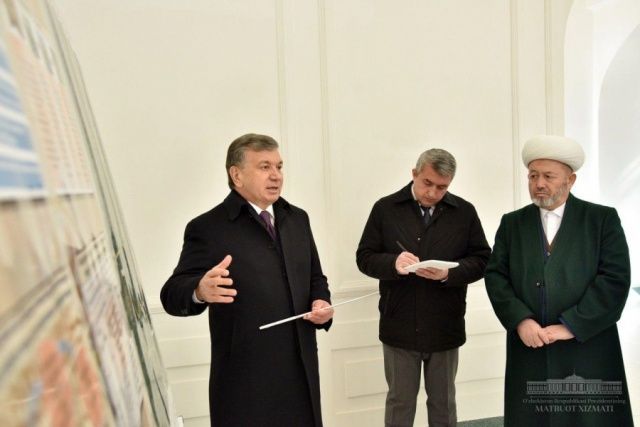
Shavkat Mirziyoyev visits the mausoleum of Bahauddin Naqshband

19.02.2018   39421   3 min.
Shavkat Mirziyoyev visits the mausoleum of Bahauddin Naqshband

The President of Uzbekistan had visited this complex on March 10, 2017, gave appropriate instructions on its further improvement, creating necessary conditions for pilgrims. 

The President inspected activities that have been implemented over the past period. 

According to tradition, surahs from the Quran were read. 

A consistent work is being carried out in accordance with the decree of President Shavkat Mirziyoyev on preparation for the 915th anniversary of Abdulhalik Gijduvani’s birth and the 700th anniversary of Bahauddin Naqshband’s birth of July 11, 2017. The Head of the state was provided with information on the “road map” of spiritual-enlightenment, scientific-practical events in connection with these anniversaries.

 
Shavkat Mirziyoyev visits the mausoleum of Bahauddin Naqshband 

It is planned to hold events on “Naqshbandi readings” for pilgrims, a scientific practical conference for university students, and a scientific conference for students of religious education institutions of the country on “High human qualities in teachings of Khojagon-Naqshbandiyya”. In addition, it is planned to organize an international scientific and practical conference on “Seven spiritual guides of Bukhara: renaissance value of Sufi teaching of Central Asia for the Islamic civilization”. 

The President of the country noted the need of conducting these events at a high organizational level. 

The last resting places of seven spiritual guides – Bahauddin Naqshband, Abdulhalik Gijduvani, Arif Revgari, Ali Romitani, Babai Samosi, Anjir Fagnavi, Said Amir Kulal are revered not only by people of Uzbekistan, but also by Muslims all over the world. 

The Head of the state was informed about the plans on reconstruction of these complexes and opening of new tourist routes. Therefore, it is planned to restore the mausoleums, landscape their territories, build hotels, teahouses, shopping complexes and parking lots. 

The distance between these complexes is 122 kilometers. Shavkat Mirziyoyev gave instructions on organizing a modern infrastructure along the roads linking the mausoleums. In addition, the need was noted for organizing a special faculty on studying the history of Bukhara in Bukhara State University. 

Along the roads linking the mausoleums of seven spiritual guides, it is necessary to establish stands with information about their lives and activities, for pilgrims. To do this, it is necessary to pay attention to training personnel, emphasized the President. 

The Head of the state considered each of the submitted projects, gave instructions on their development. 


Abu Bakir Urozov, UzA
Articles
Other posts
News

“Al Jazeera”: Uzbekistan holds a distinguished place in the formation and development of Islamic Civilization

09.09.2026   49579   2 min.
 “Al Jazeera”: Uzbekistan holds a distinguished place in the formation and development of Islamic Civilization

An article entitled “4 Eras and 10 Figures Tell the History of Islam in Uzbekistan” has been published on the website of Qatar-based television network “Al Jazeera”, reports Dunyo IA.

Article was authored by “Al Jazeera” media network journalist Muhammad Ammari, who took part in the international media forum recently held in Tashkent and Samarkand.

Article highlights the Center for Islamic Civilization in Uzbekistan and the museum located within the center. It provides an in-depth account of the formation and development of Islamic civilization in the territory of Uzbekistan through historical monuments, manuscripts, archaeological finds and the scientific legacy of outstanding thinkers.

Article notes that the museum houses around 8,000 historical artefacts and exhibits, through which the contribution of the peoples of Mawarannahr to the development of science and culture from ancient times is showcased.

Particular attention in the article is given to the fact that the museum’s exhibitions cover four major historical periods. These include the pre-Islamic era, the period of the First Renaissance in Mawarannahr, Temurid era, as well as a separate hall displaying valuable Quran manuscripts that constitute an important part of the heritage of Islamic civilization.

A significant part of the article is devoted to outstanding scholars and thinkers who left a profound mark on the history of Uzbekistan and Central Asia. The article highlights the contributions of Muhammad al-Khwarizmi, Ahmad al-Farghani, Imam al-Bukhari, Imam al-Tirmidhi, Abu Ali ibn Sina, Abu Rayhan al-Biruni, Abu Nasr al-Farabi, Mirza Ulugh Beg, Kamal al-Din Behzad, Amir Temur, and Zahiriddin Muhammad Babur to the development of science, religion, culture, art and governance.

Overall, the article seeks to demonstrate that the territory of present-day Uzbekistan has, since ancient times, been one of the major centers of Eastern civilization.

Article also emphasizes that historical exhibits at the museum are harmoniously integrated with modern technologies, including 3D reconstructions, interactive screens, and multimedia tools. This enables Uzbekistan’s rich historical, scientific and cultural heritage to be presented extensively to both local residents and international tourists.