New scholars like Bukhariy and Termiziy are expected from recently established Islamic Academy
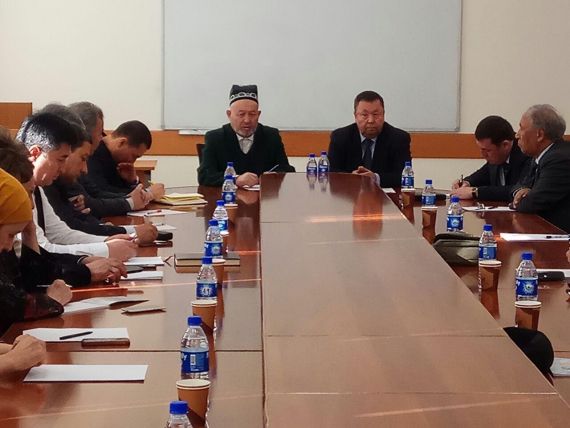
On January 25 Uzbekistan National University hosted the first meeting of scientific council of Islamic Academy. Academicians, scientists, professors, members of scientific councils and religious leaders participated in the event.
In his speech N.Ibrohimov noted that President’s decree on “Establishment of Islamic Academy of Uzbekistan” inspired many scholars working in this sphere. The Academy offers two-years master’s program and three years doctor’s program.
On his turn Muftiy Usmankhan Alimov underlined that the academy had been initiated by the President of Uzbekistan where “Quran Studies”, “Fikh sciences”, “Khadis sciences” and “Kalam science” will deeply researched by young scholars with the hope to educate scientists like Imam Bukhariy, Imam Termiziy, Abdulkholik Gijduvoniy and Bakhouddin Naqshband.
The participants also discussed the organizational issues of the new educational establishment.
Press Service,
Muslim Board of Uzbekistan
“Arab Tourist”: Cities of Uzbekistan have historically been associated with trade routes known as the Silk Road

Tourism publication “Arab Tourist” has published an article dedicated to Uzbekistan, a unique country located in the heart of Central Asia and closely associated with the rich heritage of the Silk Road, reports Dunyo IA.
Publication highlights an interesting geographical feature: as a landlocked republic, Uzbekistan, together with Liechtenstein, is one of only two countries in the world that are completely surrounded by countries that are also landlocked.
Publication pays particular attention to the historical significance of the ancient cities along the Silk Road, which connected China with Central Asia, the Middle East and Europe. Samarkand, with its famous Registan Square, Bukhara, with its numerous mosques and madrasas and Khiva, with the ancient architectural complex of Itchan Kala, are presented as key centres of trade, science and Islamic civilisation, whose rich cultural heritage attracts travellers from around the world.
Article also describes the country’s unique natural and geographical diversity, ranging from the vast areas of the Kyzylkum Desert and the mountain ranges of the Tien Shan and Pamir-Alay to the fertile Fergana Valley. It highlights the important role of agriculture, specialising in the cultivation of cotton, grains, fruits and vegetables, and also addresses the region’s environmental challenges, including the fate of the Aral Sea.
“Arab Tourist” publication emphasises that modern Uzbek cities such as Tashkent, Samarkand, Bukhara, Khiva, Namangan and Andijan seamlessly combine the functions of administrative, economic and tourism centres, while carefully preserving the legacy of great historical figures in science, including the outstanding astronomer and mathematician Ulugh Beg.

- «
- »