Qur’an contest winners of Zamin, Djizzak region were announced
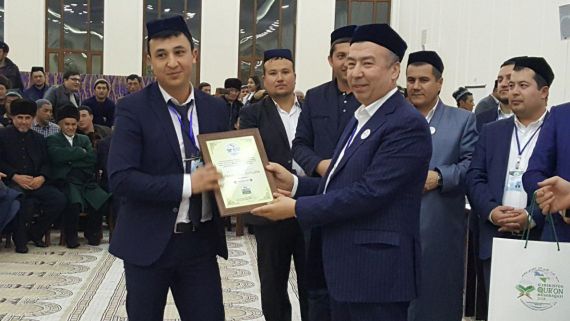
The regional rounds of Republican Qur’an Contest in Djizzak region ended in high spirit. The competition which is being held with the initiative of the President Shavkat Mirziyoyev was meant to discover new talents with the idea to support them in the future.
Here’s the list of winners.
MALE PARTICIPANTS
The first qualifying area:
Winners in Hifz (Qur’an memorization):
18-25 years old participants:
1st place – Dovudov Muzaffar
26-40 years old participants:
1st place – Saidazimov Abdulhamid
2nd place – Nishonov Abdurauf
3rd place – Malikov Sanjar
Winners in Tilawat nomination:
18-25 years old participants:
1st place – Khidirboyev Khusan
2nd place – Rahmatullayev Muhammaddiyor
3rd place – Kholturayev Abdurrazzoq, Khushbokov Sayoriddin
26-40 years old participants:
1st place – Mahmudov Bayozkhon
2nd place – Abdullayev Olimjon
3rd place – Turdiyev Sanjar
The second qualifying area:
Winners in Hifz (Qur’an memorization):
26-40 years old participants:
1st place – Atabayev Izzatulloh
Winners in Tilawat nomination:
18-25 years old participants:
1st place – Khamidov Islmojon
2nd place – Elmurotov Doniyor
3rd place – Urazametov Sardor
26-40 years old participants:
1st place – Mirzayev Abdusamad
2nd place – Norbotirov Abbos
3rd place – Abdurahimov Doston
FEMALE PARTICIPANTS
The first qualifying area:
Winners:
18-25 years old participants:
1st place – Atabayeva Nafisa
2nd place – Rashidova Niso
3rd place – Ubaydullayeva Soliha
26-40 years old participants:
1st place – Mirzakulova Makhsuda
2nd place – Ismatullayeva Mekhriniso
3rd place – Isayeva Markhabo
The second qualifying area:
Winners in Hifz (Qur’an memorization):
26-40 years old participants:
1st place – Bozorova Yorqinoy
2nd place – Qirjigitova Bibioysha
3rd place – Hakimova Dilnoza
Press Service,
Muslim Board of Uzbekistan
“Al-Ahram Weekly”: Uzbekistan reclaims its status as a global cultural hub

Egyptian publication “Al-Ahram Weekly” has published an article titled “Uzbekistan’s cultural renaissance: How the Silk Road Civilization is reclaiming its voice on the global stage”, highlights the country's cultural revival, the development of the creative economy and the expansion of international cultural cooperation, reports Dunyo IA.
Publication notes that for centuries, Uzbekistan sat at the very heart of the Great Silk Road, connecting the civilizations, religions and cultures of Asia, the Middle East and Europe and today, it is once again capturing the attention of the global community.
According to Gayane Umerova, Head of the Department of Creative Economy and Tourism of the Administration of the President of Uzbekistan, under the initiative of President Shavkat Mirziyoyev, culture, tourism and the creative economy are envisioned as fundamental pillars of the nation’s future, alongside infrastructure and industry. This approach, as noted, defines the state mandate to open Uzbekistan to the world and to welcome the world back to Uzbekistan.
Publication highlights that the nation's strategy extends beyond restoring historical sites to establishing new cultural platforms, including the Bukhara Biennial, the Center for Contemporary Art in Tashkent, the future Jadid Heritage Museum and international exhibition participation. This approach signifies a multifaceted cultural development policy.
Publication separately underscores the development of the creative economy and its nexus with cultural diplomacy and the nation’s investment attractiveness. It notes that every major cultural initiative in Uzbekistan is originally designed with a strategic focus on tourism development and investment attraction, including the “Samarkand Express” project, implemented in partnership with the Italian company “Arsenale Group”.
Publication also highlights the international acclaim received by Uzbekistan’s cultural projects, including the nation’s “Garden of Knowledge” pavilion at “Expo 2025 Osaka”, which was honored with the prestigious “Red Dot: Best of the Best” award.
Particular emphasis is placed on the preservation of Uzbekistan’s Islamic heritage, the advancement of museum infrastructure and the implementation of projects aimed at integrating historical legacy into the contemporary cultural context, including the Bukhara master development plan designed by the “Wilmotte & Associés” architectural bureau.
A dedicated section of the article focuses on Uzbekistan’s cultural cooperation with Egypt and the Arab world. It notes that the sides are discussing prospects for interaction in the fields of museum management, tourism, and cultural heritage preservation, alongside the development of institutional partnerships.
According to the publication, a highly symbolic milestone was the election of Professor Khaled El-Anany as Director-General of UNESCO during the 43rd session of the organization’s General Conference, which took place in Samarkand.
In conclusion, it underscores that Uzbekistan is envisioned as a nation that remains profoundly loyal to its traditions while simultaneously advancing modern cultural and creative industries, thereby strengthening international cultural cooperation.
