The site is working in test mode!
23 August, 2026   |   10 Rabī‘ al-awwal, 1448

Tashkent city
Fajr
04:15
Sunrise
05:40
Dhuhr
12:26
Asr
17:12
Maghrib
19:15
Isha
20:36
Bismillah
23 August, 2026, 10 Rabī‘ al-awwal, 1448

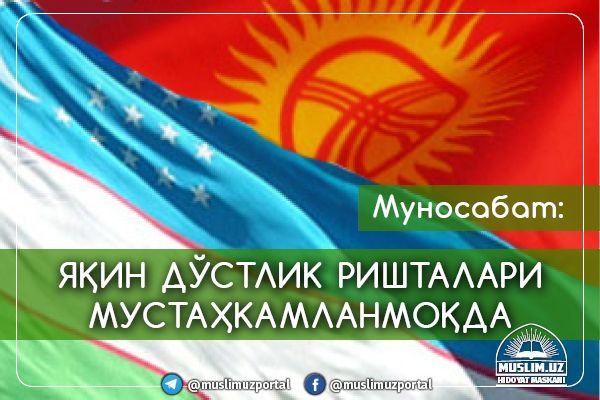
Close friendship relationships are strengthening.

15.12.2017   26342   4 min.
Close friendship relationships are strengthening.

Uzbek and Kyrgyz people have been living shoulder to shoulder for centuries. The root of these nations is the same. They lived in peace by exchanging in marriages.

Two great writers and state figures Chingiz Aytmatov and Sharof Rashidov were close friends.

After acquiring independence, Uzbekistan and Kyrgyzstan established diplomatic relations. In 1992 Kyrgyzstan opened its embassy, while Uzbekistan opened its embassy in Bishkek in 1998. In 1996 two countries signed “Agreement on Eternal Friendship” which became legal basis for the relationship for two countries. 181 official documents had been signed until 2005.

But the issue of using trans-border rivers has lately caused misunderstanding between two countries.

Nowadays these two countries which have missed previous ties are renovating their relationships now. Sooranbay Jeenbekov, President of Kyrgyzstan paid an official visit to Uzbekistan.

“Kyrgyzstan is our close neighbor. That’s why there should not be any border between us. We opened our hearts to each other and for this reason we need to solve any issue”, said President of Uzbekistan. 

In its turn, Sooronbay Jeenbekov expressed deep gratitude to Shavkat for the invitation and on behalf of people conveyed deep respect. President of Kyrgyzstan highly evaluated the efforts of Shavkat Mirziyoyev by saying: “You have turned our borders into real friendship, good neighborhood and partnership borders.”

Uzbekistan’s foreign policy highlights the importance of development successful relationships with neighbors. It has lately been observed an active integration process among Central Asian countries. Particularly, relations with Kyrgyzstan are leveling up. Visits between governmental bodies are widening.

During the meeting President Jeenbekov stressed his support for the President Mirziyoyev’s initiative for organizing constant advisory meetings with Central Asian leaders.

It is meaningful here to mention the participation of Maksatbek Toktomeshov, Muftiy of Kyrgyzstan at the International Scientific-practical conference called “Islamic solidarity in the example of Uzbekistan and Azerbaijan” which was hosted by Uzbekistan in Tashkent on October 18th of the current year. Muftiy of Kyrgyzstan Maksatbek Toktomeshov:

  • We, most of the participants of the conference, recognized each other, because our administrative office was the same before. Our fathers and grandfathers studied in this land in Tashkent and Bukhara. We are planning to open new religious institutions in our country, but for the time being we have to use educational establishments in Uzbekistan as this country has great religious knowledge and experience. I was thinking about this during the conference. The conference has become a great step forward for improving our warm relationships.

The visit of President of Kyrgyzstan to Uzbekistan will bring our relationships into new level. For this reason people of both countries are observing with great positive hopes.


Press service,

Muslim Board of Uzbekistan

Other posts
News

“Kyiv Diplomatic”: Bukhara strengthens its position as an International Cultural Centre

05.08.2026   48006   2 min.
 “Kyiv Diplomatic”: Bukhara strengthens its position as an International Cultural Centre

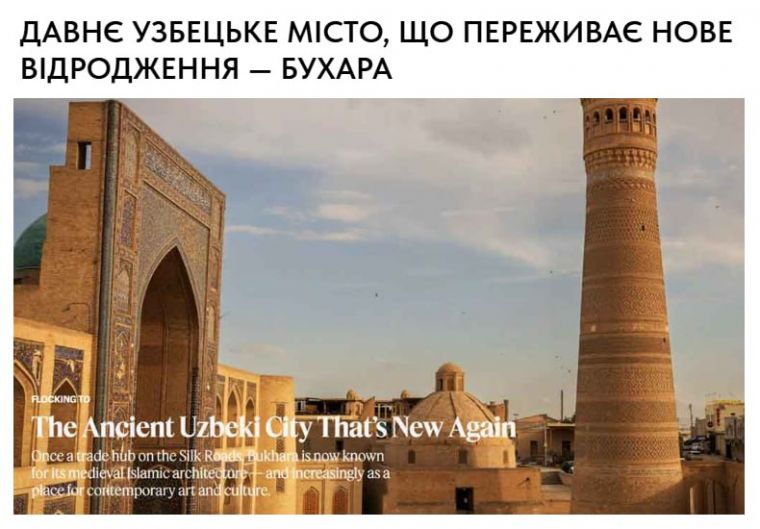
Today ancient Bukhara is once again strengthening its position as an international cultural centre and experiencing a new stage of cultural and tourism development, reports Dunyo IA correspondent, citing with reference to the Ukrainian magazine “Kyiv Diplomatic”.

Publication notes that the American newspaper “The New York Times” published an article dedicated to Bukhara, one of the oldest cities in Uzbekistan. For more than a thousand years, Bukhara remained one of the most important centres of the Great Silk Road, connecting the East and the West. Trade routes passed through the city, along which jewellery, textiles, porcelain, and other valuable goods were transported. From the 8th to the 13th centuries, Bukhara became one of the largest intellectual and cultural centres of the Islamic world, where outstanding scholars, architects, mathematicians and artists worked.

Authors of the publication pay particular attention to the city’s rich historical and architectural heritage. Bukhara has preserved the ancient Ark Fortress, mausoleums, madrasas, mosques with distinctive turquoise domes, and other landmarks, many of which are included in the UNESCO World Heritage List. More than 140 sites of the historic center are located within walking distance of one another, making the city one of the best-preserved historical complexes in Central Asia.

According to the publication, today Bukhara is once again strengthening its position as an international cultural center. One of the most important events was the first Bukhara Biennial of Contemporary Art, held in the autumn of last year. As part of the project, artists from Uzbekistan and other countries created works specifically for the city’s historic spaces, collaborated with local artisans and participated in joint cultural initiatives.

As noted in the publication, the organization of the Biennial contributed not only to the promotion of cultural heritage but also to the development of tourism infrastructure. New hotels, restaurants, cultural spaces and shops are opening in Bukhara, catering to the growing interest of international travellers.

“The New York Times” also presented its own city guide, recommending that tourists visit historical landmarks, including the Sitorai Mokhi-Khosa Palace, Chor-Bakr Memorial Complex, Baland Mosque and Khoja Zayniddin Sufi Complex.