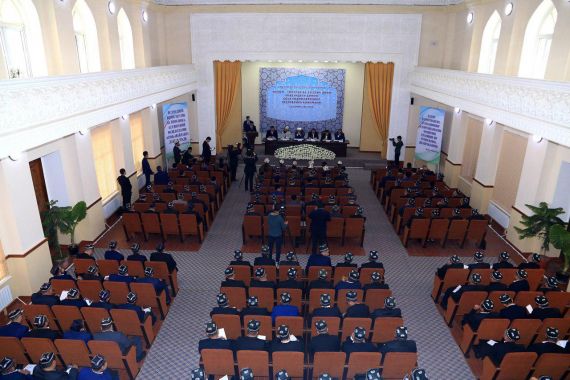
The excerpt from the speech of Usmonkhon Alimov, Chairman of Muslim Board of Uzbekistan, Muftiy dedicated to the conference which was held in Andijan province under the title “Islam – the religion of peace and morality”
Assalamu alaykum wa rohmatullohu wa barokatuhu!
Dear imams, respected teachers and guests!
Personally, I’m really happy to see you all in good health in Andijan province, the land of scholars. Welcome to the traditional republican conference of religious sphere representatives!
The current event is different from the previous one with the participation of our dearest guests from neighboring countries. They are delegations under the leadership of Makhsatbek Tokhtamishev, Chairman of Muslim Board of Kyrgyzstan, Muftiy and Karimbek Akhmadjon, Head Imam of Southern Kazakhstan province of Kazakhstan
Dear conference participants and guests!
As you are aware of, on October 18th as part of the international conference “Islamic solidarity: in the example of Azerbayjan and Uzbekistan” held in Tashkent we had talks with Mr. Erjan Mayamerov, Chairman of Muslim Board of Uzbekistan, Muftiy and Mr. Makhsatbek Tokhtamishev, Chairman of Muslim Board of Kyrgyzstan, Muftiy. During the conversations we agreed on future cooperation. The participation of our guests in today’s conference is the continuation of joint partnership.
It is evident that friendship among our close nations has been strengthening from centuries. Especially, Uzbek, Kirgiz and Kazakh nations have long historical roots. Cultural, spiritual and friendly relationships among our people are always stay in harmony. I believe that relationships based on mutual trust will further be reinforced.
“The development of cooperation between Uzbekistan and Kyrgyzstan based on mutual respect and trust is main direction of our foreign policy,” stated our President Shavkat Mirziyoyev. This makes us work more proactively.
It is also appropriate to mention Uzbek Leader’s statement about Uzbek-Kazakh relationship. “Uzbek and Kazakh people have lived shoulder by shoulder for centuries. They are people of the same root.”
In this regard it should be noted that the active inter-state official visits of our leaders once again proves that friendly and fruitful relationships between Uzbekistan-Kyrgyzstan and Uzbekistan-Kazakhstan will constantly continue.
Dear conference participants! (continues his speech Honorable Usmonkhon Alimov )
These days we are all witnessing a great deal of positive developments throughout our country. We proclaim our thanks to The Creator for participating in these noble improvements.
Today no one stays aside of the happenings in the world scene. If a conversation is about peace and prosperity, then it has stronger magnitude. We also have been gathered in this humble hall to talk about peace and morality. Peace and stability are one of the greatest gifs of Allah. The importance of this bounty is repeatedly mentioned in Islamic sources.
Unfortunately, this great bestowal of peace is not provided to all people in our Earth. We know that all meaningless wars and conflict of interests are bringing countless casualties.
In this regard it is worth mentioning the historical speech of our President on 72nd session of UN General Assembly, where he put the initiative forward that the struggle against destructive powers must be performed by education, by raising awareness of world community about the pure humane message of Islam, by calling people to preserve the essence of religion of Islam which is peace, morality and benevolent behavior. Today’s current event of religious specialists once again proves that struggle against evil is through spreading knowledge.
For this reason, in our ever-fast changing information age we need to work together even more closer than before to bring the real message of Islam, which stands against any kind of cruelty and brutality, promotes peace and harmony. Allah reminds us in the Holy Koran:
يَهْدِي بِهِ اللَّهُ مَنِ اتَّبَعَ رِضْوَانَهُ سُبُلَ السَّلَامِ وَيُخْرِجُهُمْ مِنَ الظُّلُمَاتِ إِلَى النُّورِ بِإِذْنِهِ وَيَهْدِيهِمْ إِلَى صِرَاطٍ مُسْتَقِيمٍ
Allah guides with it whoever follows His approval to the ways of peace, and He brings them out of darkness into light, by His per-mission, and He guides them in a straight path. (al-Ma’idah, 16)
The importance of peace for each person is mentioned by our dearest prophet Muhammad (S.A.W.):
“If one of you awakens in the morning and finds his family in peace, his health in good condition and possesses food for one day, he possesses the bounty of the whole world” (narrated by Imam Bukhari)
Dear guests in order to preserve our greatest reward which we call peace, we, religious leaders, have to work harder.
Today our country has put new steps towards development and this is the greatest endowment of Allah. With the gratitude I underline that our President is paying special attention to reconstruct divine shrines of Islamic scholars and building new mosques and madrasahs.
Only during the last year “Imam Eshon Muhammad” mosque in Karakalpakstan, “Okhun Bobo” mosque in Khorezm, “Imam Termiziy” and “Suzuk Ota” mosque in Tashkent were built in a big complex style, Imam Termiziy Shrine in Surkhandarya, Abu Muin Nasafiy Shrine in Kashkadarya were reconstructed, a new Mir Arab Higher Madrasa in Bukhara and Imam Termiziy international scientific-research center in Termez city were established.
Especially, the establishment of “Imam Bukhari International scientific-research center” in Samarkand has given an opportunity to study the rich scientific heritage of our ancestors not only for our scholars, but for the researchers from the whole world.
The expected launching of Islamic Civilization Center is expected to extend the fame of our country to far boundaries, to re-announce the name of our famous scholars to the whole world. And also Islamic Academy under the Islamic Civilization Center and other special schools for aqidah, kalam, jurisprudence and hadith sciences will raise new Imam Bukhari, Imam Termiziy, Imam Moturidi, Imam Marghilanis from our young generation.
Considering all aforementioned, all religious specialists employed within Muslim Board of Uzbekistan have put the following tasks in order to preserve peace and harmony in our country:
– Today every imam should be able to understand well all changes in new development stage of our country and be able to explain people about the reality. If we are passionate about the future of our Motherland, then we have to protect our citizens from negative influences;
– During Friday sermons imams should clearly denounce all brutalities happening around the world by explaining that there are some powers behind these acts, and proclaiming any inhumane act in any part of the world to be the tragedy of the whole humanity
– To request citizens during the preaches to be aware of dangerous ideologies spread on internet by advising to use official website of Muslim Board of Uzbekistan and other local internet sources linked on www.muslim.uz We deeply regret about the incident which happened in the US. Undoubtedly these kinds of evil deeds will surely reflect the ones who plot them. Allah mentions in the Holy Koran: “Priding themselves on earth, and scheming evil. But evil scheming overwhelms none but its authors.”(Fatir, 43)
– To talk about the negative sides of “mass culture” by advising to follow the teachings of our ancestors;
–The main purpose of destructive groups is to bring conspiracy among worshippers. Our people have been following Moturudiya aqidah and Hanafiy Mazhab for centuries. But some young people while travelling abroad are getting acquainted with some other destructive thoughts and when they return they start blaming other local worshippers on performing prayers differently. It is imams duty to clearly explain and teach our respected Islamic tradition of Hanafiya school so that young people would understand between right and wrong.
Dear conference participants!
Recently, Samarkand held International Conference on Providing Security and Sustainable Development in Central Asia under UN patronage. In this event our President Shavkat Mirziyoyev noted that common goal is bring Central Asia into Sustainable Developed Area for that reason and the best way to prevent young people from falling into extremism was to educate young about pure humane essence of religion.
Wassalamu alaykum wa rohmatullohu wa barokatuhu!
The press service of the Uzbekistan Muslim Board



 Iman
Iman  Prayer
  Fasting
  Zakat
Zakat  Haj
Haj  Qur`an
  Lessons of Islam
  Contact