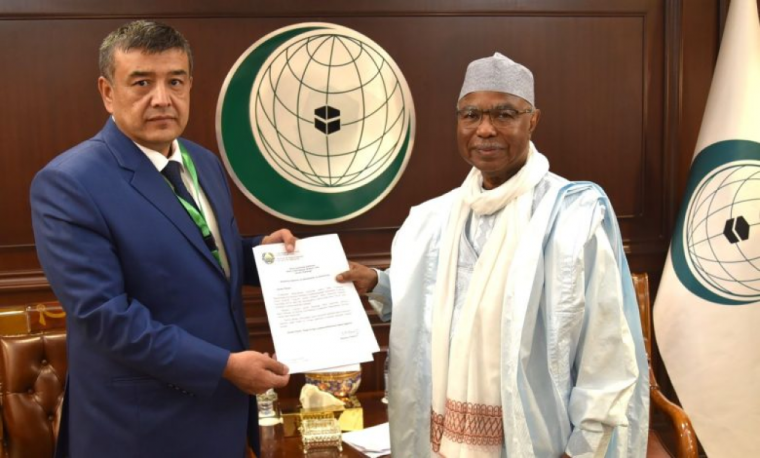
Accepting the credentials of the permanent representative, the OIC Secretary General congratulated him on assuming the office and wished him success in carrying out his responsible mission.
The current state and prospects of cooperation between Uzbekistan and OIC were discussed during the meeting. The sides also expressed mutual interest in intensifying interaction in such important areas as education, support for youth and innovations.
The OIC Secretary General noted Uzbekistan's significant contribution to the development of Islamic civilization, science and culture, stressing that the country has historically been the center of scientific discoveries, philosophical thought and spiritual heritage of the Islamic world. It was also emphasized that today Uzbekistan continues to play an important role in strengthening the unity of the Islamic Ummah, promoting initiatives aimed at sustainable development, education and preservation of cultural heritage, which makes it one of the key partners in implementing the goals of the Organization of Islamic Cooperation.
It is worth recalling that Nodirjon Turgunov arrived in Riyadh in March 2024 as the Ambassador of Uzbekistan to Saudi Arabia.
He served as Consul General in the city of Jeddah from 2021 to 2024.
He has been in the system of the MFA since 2016. He worked in various positions in the Consular and Legal Department of the Ministry of Foreign Affairs. In 2019-2021 he served as Consul General of Uzbekistan in the city of Aktau (Kazakhstan), in 2021-2024 - in the city of Jeddah (Saudi Arabia).
He speaks Arabic and Russian.
Nodirjon Turgunov replaced Ulugbek Maksudov, who served from 2018-2024 as the Ambassador of Uzbekistan to Saudi Arabia and permanent representative to the Organization of Islamic Cooperation, headquartered in the city of Jeddah.
One of Iraq's leading Arabic-language newspapers, “Azzaman”, has published an article entitled “Uzbekistan on the 35th Anniversary of Independence: From State-Building to the Third Renaissance”, reports Dunyo IA .
Article highlights Uzbekistan's development path over the years of independence, the large-scale reforms implemented across the country, and the republic's growing standing on the international stage.
It notes that the country's independence in 1991 marked a historic turning point in the life of the Uzbek people, laying the foundations for national statehood, establishing the basis for economic development and ensuring social stability.
Particular attention is paid to the large-scale transformations carried out since 2016 under the leadership of President Shavkat Mirziyoyev within the framework of the New Uzbekistan concept. The article emphasizes that these reforms have earned the country recognition as a state pursuing consistent and balanced development in Central Asia.
Publication also highlights reforms in the social sphere, including improvements to the social protection system, enhanced quality of education and healthcare, as well as initiatives aimed at expanding the participation of young people and women in public life.
Article places particular emphasis on the concept of the Third Renaissance put forward by President Shavkat Mirziyoyev, describing it as one of the country's key strategic development priorities. It notes that the homeland of such eminent scholars as Muhammad al-Khwarizmi, Abu Rayhan al-Biruni, Abu Ali Ibn Sina, Imam al-Bukhari and Imam al-Tirmidhi is today striving to usher in a new era of the Third Renaissance by advancing science, innovation, technology and human capital.
Publication also highlights Uzbekistan's open, pragmatic and balanced foreign policy, its commitment to the principles of good-neighborliness, and its efforts to strengthen cooperation with international and regional organizations. Particular emphasis is placed on the country's role in promoting peace, stability and regional cooperation in Central Asia.
In conclusion, article emphasizes that Uzbekistan's 35 years of independent development demonstrate its unwavering commitment to the path of renewal, constructive development and sustainable progress. It notes that, by harmoniously combining its rich historical and cultural heritage with modern development principles, the country is laying a solid foundation for a prosperous and sustainable future for coming generations.