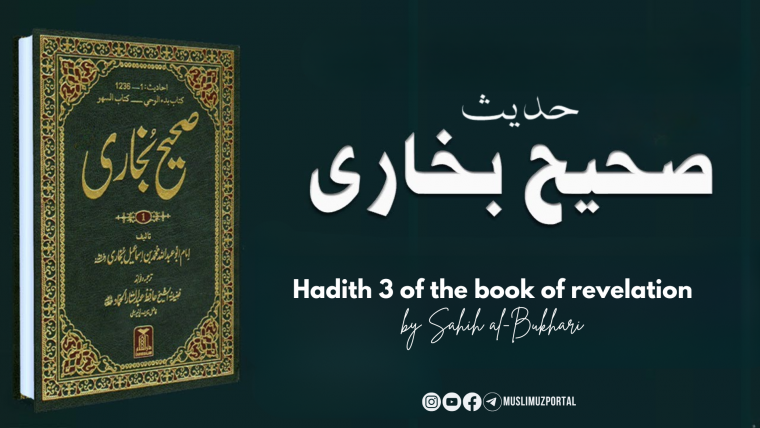
(3) Hadith 3 of the book of revelation by Sahih al-Bukhari
حَدَّثَنَا يَحْيَى بْنُ بُكَيْرٍٍ، قَالَ: حَدَّثَنَا اللَّيْثٍُ، عَنْ عُقَيْلٍٍ، عَنِ ابْنِ شِهَابٍٍ، عَنْ عُرْوَةَ بْنِ الزُّبَيْرٍِ، عَنْ عَائِشَةٍَأُمِّ الْمُؤْمِنِينَ، أَنَّهَا، قَالَتْ: "أَوَّلُ مَا بُدِئَ بِهِ رَسُولُ اللَّهِ صَلَّى اللَّهُ عَلَيْهِ وَسَلَّمَ مِنَ الْوَحْيِ الرُّؤْيَا الصَّالِحَةُ فِي النَّوْمِ، فَكَانَ لَا يَرَى رُؤْيَا إِلَّا جَاءَتْ مِثْلَ فَلَقِ الصُّبْحِ، ثُمَّ حُبِّبَ إِلَيْهِ الْخَلَاءُ وَكَانَ يَخْلُو بِغَارِ حِرَاءٍ، فَيَتَحَنَّثُ فِيهِ وَهُوَ التَّعَبُّدُ اللَّيَالِيَ ذَوَاتِ الْعَدَدِ قَبْلَ أَنْ يَنْزِعَ إِلَى أَهْلِهِ وَيَتَزَوَّدُ لِذَلِكَ، ثُمَّ يَرْجِعُ إِلَى خَدِيجَةَ فَيَتَزَوَّدُ لِمِثْلِهَا حَتَّى جَاءَهُ الْحَقُّ وَهُوَ فِي غَارِ حِرَاءٍ، فَجَاءَهُ الْمَلَكُ، فَقَالَ: اقْرَأْ، قَالَ: مَا أَنَا بِقَارِئٍ، قَالَ: فَأَخَذَنِي فَغَطَّنِي حَتَّى بَلَغَ مِنِّي الْجَهْدَ، ثُمَّ أَرْسَلَنِي، فَقَالَ: اقْرَأْ، قُلْتُ: مَا أَنَا بِقَارِئٍ، فَأَخَذَنِي فَغَطَّنِي الثَّانِيَةَ حَتَّى بَلَغَ مِنِّي الْجَهْدَ، ثُمَّ أَرْسَلَنِي، فَقَالَ: اقْرَأْ، فَقُلْتُ مَا أَنَا بِقَارِئٍ، فَأَخَذَنِي فَغَطَّنِي الثَّالِثَةَ، ثُمَّ أَرْسَلَنِي فَقَالَ: "اقْرَأْ بِاسْمِ رَبِّكَ الَّذِي خَلَقَ 1 خَلَقَ الإِنْسَانَ مِنْ عَلَقٍ 2 اقْرَأْ وَرَبُّكَ الأَكْرَمُ 3 "سورة العلق آية 1-3، فَرَجَعَ بِهَا رَسُولُ اللَّهِ صَلَّى اللَّهُ عَلَيْهِ وَسَلَّمَ يَرْجُفُ فُؤَادُهُ، فَدَخَلَ عَلَى خَدِيجَةَ بِنْتِ خُوَيْلِدٍ رَضِيَ اللَّهُ عَنْهَا، فَقَالَ: زَمِّلُونِي زَمِّلُونِي، فَزَمَّلُوهُ حَتَّى ذَهَبَ عَنْهُ الرَّوْعُ، فَقَالَ لِخَدِيجَةَ، وَأَخْبَرَهَا الْخَبَرَ: لَقَدْ خَشِيتُ عَلَى نَفْسِي، فَقَالَتْ خَدِيجَةُ: كَلَّا وَاللَّهِ مَا يُخْزِيكَ اللَّهُ أَبَدًا، إِنَّكَ لَتَصِلُ الرَّحِمَ، وَتَحْمِلُ الْكَلَّ، وَتَكْسِبُ الْمَعْدُومَ، وَتَقْرِي الضَّيْفَ، وَتُعِينُ عَلَى نَوَائِبِ الْحَقِّ، فَانْطَلَقَتْ بِهِ خَدِيجَةُ حَتَّى أَتَتْ بِهِ وَرَقَةَ بْنَ نَوْفَلِ بْنِ أَسَدِ بْنِ عَبْدِ الْعُزَّى ابْنَ عَمِّ خَدِيجَةَ، وَكَانَ امْرَأً تَنَصَّرَ فِي الْجَاهِلِيَّةِ، وَكَانَ يَكْتُبُ الْكِتَابَ الْعِبْرَانِيَّ، فَيَكْتُبُ مِنَ الْإِنْجِيلِ بِالْعِبْرَانِيَّةِ مَا شَاءَ اللَّهُ أَنْ يَكْتُبَ، وَكَانَ شَيْخًا كَبِيرًا قَدْ عَمِيَ، فَقَالَتْ لَهُ خَدِيجَةُ: يَا ابْنَ عَمِّ، اسْمَعْ مِنَ ابْنِ أَخِيكَ، فَقَالَ لَهُ وَرَقَةُ: يَا ابْنَ أَخِي، مَاذَا تَرَى، فَأَخْبَرَهُ رَسُولُ اللَّهِ صَلَّى اللَّهُ عَلَيْهِ وَسَلَّمَ خَبَرَ مَا رَأَى، فَقَالَ لَهُ وَرَقَةُ: هَذَا النَّامُوسُ الَّذِي نَزَّلَ اللَّهُ عَلَى مُوسَى صَلَّى اللَّهُ عَلَيْهِ وَسَلَّمَ، يَا لَيْتَنِي فِيهَا جَذَعًا، لَيْتَنِي أَكُونُ حَيًّا إِذْ يُخْرِجُكَ قَوْمُكَ، فَقَالَ رَسُولُ اللَّهِ صَلَّى اللَّهُ عَلَيْهِ وَسَلَّمَ: أَوَمُخْرِجِيَّ هُمْ، قَالَ: نَعَمْ، لَمْ يَأْتِ رَجُلٌ قَطُّ بِمِثْلِ مَا جِئْتَ بِهِ إِلَّا عُودِيَ، وَإِنْ يُدْرِكْنِي يَوْمُكَ أَنْصُرْكَ نَصْرًا مُؤَزَّرًا، ثُمَّ لَمْ يَنْشَبْ وَرَقَةُ أَنْ تُوُفِّيَ وَفَتَرَ الْوَحْيُ".
Sahih hadith: Narrated 'Aisha: (the mother of the faithful believers) The commencement of the Divine Inspiration to Allah's Apostle was in the form of good dreams which came true like bright daylight, and then the love of seclusion was bestowed upon him. He used to go in seclusion in the cave of Hira where he used to worship (Allah alone) continuously for many days before his desire to see his family. He used to take with him the journey food for the stay and then come back to (his wife) Khadija to take his food likewise again till suddenly the Truth descended upon him while he was in the cave of Hira. The angel came to him and asked him to read. The Prophet replied, I do not know how to read. The Prophet added, The angel caught me (forcefully) and pressed me so hard that I could not bear it any more. He then released me and again asked me to read and I replied, 'I do not know how to read.' Thereupon he caught me again and pressed me a second time till I could not bear it any more. He then released me and again asked me to read but again I replied, 'I do not know how to read (or what shall I read)?' Thereupon he caught me for the third time and pressed me, and then released me and said, 'Read in the name of your Lord, who has created (all that exists), created man from a clot. Read! And your Lord is the Most Generous. (96.1, 96.2, 96.3) Then Allah's Apostle returned with the Inspiration and with his heart beating severely. Then he went to Khadija bint Khuwailid and said, Cover me! Cover me! They covered him till his fear was over and after that he told her everything that had happened and said, I fear that something may happen to me.
Khadija replied, Never! By Allah, Allah will never disgrace you. You keep good relations with your kith and kin, help the poor and the destitute, serve your guests generously and assist the deserving calamity-afflicted ones. Khadija then accompanied him to her cousin Waraqa bin Naufal bin Asad bin 'Abdul 'Uzza, who, during the pre-Islamic Period became a Christian and used to write the writing with Hebrew letters. He would write from the Gospel in Hebrew as much as Allah wished him to write. He was an old man and had lost his eyesight. Khadija said to Waraqa, Listen to the story of your nephew, O my cousin! Waraqa asked, O my nephew! What have you seen? Allah's Apostle described whatever he had seen. Waraqa said, This is the same one who keeps the secrets (angel Gabriel) whom Allah had sent to Moses. I wish I were young and could live up to the time when your people would turn you out. Allah's Apostle asked, Will they drive me out? Waraqa replied in the affirmative and said, Anyone (man) who came with something similar to what you have brought was treated with hostility; and if I should remain alive till the day when you will be turned out then I would support you strongly. But after a few days Waraqa died and the Divine Inspiration was also paused for a while.
Reference: Sahih al-Bukhari 1: Chapter 1, Hadith 3
Facilitated by the Permanent Delegation of Uzbekistan to UNESCO, an online meeting was held between representatives of Uzbekistan and the Secretariat of the 2003 UNESCO Convention for the Safeguarding of the Intangible Cultural Heritage, dedicated to the cultural traditions and practices associated with the mahalla, as well as prospects for their promotion at the international level, reports Dunyo IA.
UNESCO Convention for the Safeguarding of the Intangible Cultural Heritage was adopted in 2003 and aims to safeguard living cultural traditions, customs, knowledge, skills and forms of cultural expression transmitted from generation to generation by communities. Operating within the framework of the Convention are the Representative List of the Intangible Cultural Heritage of Humanity, the List of Intangible Cultural Heritage in Need of Urgent Safeguarding and Register of Good Safeguarding Practices.
On behalf of UNESCO, the consultation was attended by Fumiko Ohinata, Secretary of the Convention for the Safeguarding of the Intangible Cultural Heritage and Nicholas Tan, Associate Programme Specialist responsible for the Asia and the Pacific region. Uzbek side was represented by officials from the Ministry of Foreign Affairs, the Mahalla Association of Uzbekistan, the National Commission for UNESCO and Permanent Delegation of the country to UNESCO.
During the meeting, the Uzbek side presented the centuries-old history of the mahalla, its special role in the life of society and its significance in preserving national traditions. It was emphasized that the mahalla is an integral part of the lifestyle of the people of Uzbekistan, uniting individuals on the basis of the principles of good neighbourliness, mutual assistance, solidarity and respect for the older generation.
Particular attention was paid to the cultural dimension of the mahalla. For centuries, it has served as a space where traditions are preserved directly in people's daily lives: holidays and important family events are celebrated collectively, customs of mutual assistance are maintained, intergenerational relations are strengthened and knowledge, values and life experience are transmitted to the youth.
Representatives of the UNESCO Secretariat reviewed the presented materials with great interest and noted the distinct nature of the social lifestyle centered around the mahalla in Uzbekistan. During the conversation, the significance of the traditions of community life, cultural interaction and the intergenerational transmission of heritage was emphasized as vital components of living intangible cultural heritage.
UNESCO experts also noted that the value of such traditions lies in their constant presence in people's lives. Cultural heritage within the mahalla is not limited to the preservation of individual customs but continues to manifest itself in daily interaction, relations between neighbours, collective events, and the participation of different generations in the life of the community.
During the exchange of views, it was noted that the experience of the mahalla reflects the way of organizing community life characteristic of Uzbekistan, where cultural values are preserved by the people themselves, further developed, and transmitted to subsequent generations. UNESCO representatives emphasized that such forms of interaction within local communities could be of significant interest in the context of the “living heritage” concept that underpins the 2003 Convention.
The role of Uzbekistan in promoting intangible cultural heritage and its contribution to enhancing international awareness of the diversity of living cultural traditions were separately highlighted. In this regard, the presented experience of the Uzbek mahalla generated significant interest among the Secretariat specialists.
Consultation held marked another step in developing cooperation between Uzbekistan and UNESCO on the preservation and international promotion of the country’s rich intangible cultural heritage, including the unique traditions and values formed within the institution of the mahalla.