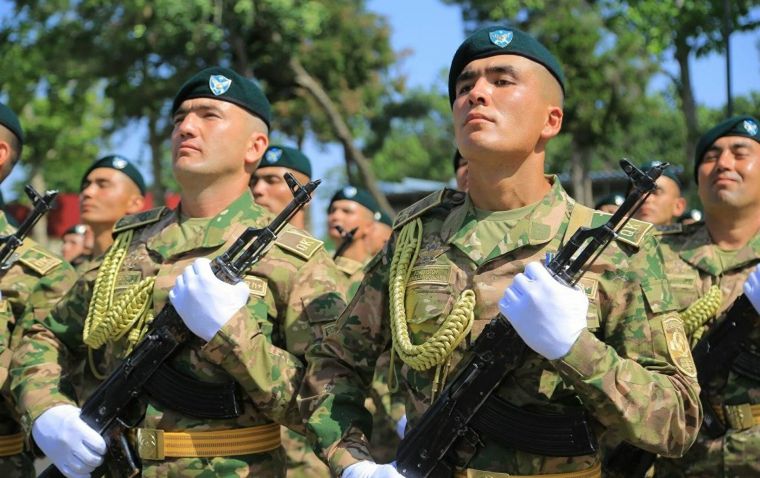
What do you know about the 14th of January – the Day of Defenders of the Motherland of Uzbekistan? There are many professions in the world, but being a defender of the motherland is one of the most honorable. It is an honor to protect one’s family, home, and children. Therefore, the Day of Defenders of the Motherland is a national holiday for the Uzbek people.
The history of this day in Uzbekistan dates back to 1992 when, on January 14, the country’s parliament decided to transfer all military units, educational institutions, and other formations stationed on the territory of Uzbekistan under the jurisdiction of the Republic. Since then, every year on January 14, Uzbekistan celebrates this significant state holiday.
Motherland Defenders Day in Uzbekistan is celebrated widely and spectacularly. According to tradition, the anthem of the Republic of Uzbekistan is performed on Independence Square in the capital. Military units march through the square with a solemn parade accompanied by a military orchestra. Participants in the parade also lay wreaths at the foot of the Monument of Independence.
The Day of Defenders of the Motherland is also known as Uzbek Army Day. It is the official professional holiday of the Uzbek Armed Forces. Before 1992, Uzbekistan, as part of the former Soviet Union, observed Soviet Army and Navy Day. After gaining independence, countries like Russia, Belarus, Kyrgyzstan, Tajikistan, and Kazakhstan continued to celebrate Soviet Army and Navy Day as Defender of the Fatherland Day. However, on December 29, 1993, the Uzbek Parliament officially established the Day of Defenders of the Motherland to commemorate the anniversary of the formation of the country’s armed forces.
On this day, military units of the Tashkent Garrison line up in Independence Square and receive congratulations and awards from the president and the minister of defense. Holiday activities also include wreath-laying ceremonies at the Monument to the Independence of Uzbekistan and the Amir Timur Monument.
To celebrate this holiday in a high and impressive spirit, President Shavkat Mirziyoyev issued a decree on the 30th anniversary of the establishment of the Armed Forces of the Republic of Uzbekistan, emphasizing the need for grand celebrations.
According to the noble ideas of President Shavkat Mirziyoyev, “The Army and the people stick together.” This principle is reflected in the practical actions of authorities, neighborhoods, youth and women’s organizations, educational institutions, and the general public. This shows that defending the Motherland is not only a duty but also an honorable responsibility.
Military personnel and veterans who have devoted their lives to protecting the Motherland are honored with great respect every year. The Day of Defenders of the Motherland is celebrated with great enthusiasm and joy, highlighting the value of these professionals’ service to the nation.
Protecting the Motherland is a sacred duty for all. The National Army and law enforcement agencies play a crucial role in ensuring the peaceful and stable life of the people and creating the necessary conditions for their well-being.
In today’s world, with increasing threats of international terrorism, extremism, and radicalism, it is essential for our Armed Forces to maintain a high level of combat readiness. Significant reforms in military and political fields have strengthened the National Army, making it more capable of responding to any threats.
Additionally, the knowledge, skills, and mental training of every serviceman are continuously improving. The military profession has always been considered both demanding and honorable. Our soldiers endure harsh conditions, guarding the peace of our homeland day and night, in both cold and heat.
Efforts to strengthen the country’s defense capabilities, foster patriotism among youth, and enhance public involvement in supporting the army have reached a new qualitative level.
Today, we can proudly say that our National Army has become a reliable guarantor of our borders’ security. By applying global best practices in military patriotism, construction, and industry, our armed forces have become a source of pride. Modern servicemen exemplify loyalty, bravery, and selflessness, demonstrating deep knowledge, strong will, and firm preparation to fulfill their sacred duty.
Across the globe, people dedicate their lives to maintaining peace and safeguarding their homeland. This noble profession is universally respected and honored. On January 14th, we commemorate the establishment of Uzbekistan’s Armed Forces. In 2025, the people of Uzbekistan will proudly celebrate the 33rd anniversary of the Day of Defenders of the Motherland.
Internet sources:
- en.wikipedia.org
- people-travels.com
- suit.uz
- nspi.uz
Fakhriddin Yernazarov,
Senior Teacher of the “Languages” Department
of the Tashkent Islamic Institute named after Imam al-Bukhari.



 Iman
Iman  Prayer
  Fasting
  Zakat
Zakat  Haj
Haj  Qur`an
  Lessons of Islam
  Contact