Do you know about the life and activity of Zahiriddin Muhammad Babur? The name of Zahiriddin Muhammad Babur in the history of Uzbekistan is on a par with such political figures and military leaders as Jaloliddin Manguberdi, Amir Timur, Mirzo Ulugbek and Mir Alisher Navoi. A direct descendant of Timur, Babur created an empire of Baburids in India (in the western sources it is known as Mughal Empire) and was a loyal son of his country and the rest of his life he was fighting for its welfare and prosperity.
Babur was the son of the Timurid prince Umarsheykh, the ruler of the Fergana region. He was born on February 14, in 1483 in Andijan. At the age of 12 years, resulting in the tragic death of his father, he became the new ruler and started a brutal struggle for power in Mawarannahr. During 1494-1496, while still a teenager, Babur participated in the battles of Samarkand, where he first met on the battlefield with his most powerful enemy, Sheybani Khan, who had an enormous impact on the fate of Babur. Most of his life Babur spent in military campaigns and battles. He tried unsuccessfully to unite the separated regions of Mawarannahr and create a new great state of Temurids. His dream was realized in India, where he went with his troops in 1526. Babur succeeded in laying the basis for the Great Mughal Dynasty in India, which had existed for about 300 years. His ideas preached the establishment of harmony among the peoples and spread of education among the general population.
He died in 1530, December 26, in Agra. His grave was in Agra but then it was brought to Kabul and buried there.
Along with his military and political activities Babur was a great poet, whose rubais (lyric quatrains) delight and inspire many people even today. He wrote one of the most famous oriental works in world literature: “Baburnama”. “Baburnama” is personal letters of Babur, which he has kept throughout life and collected in one work. “Baburnama” is not only a description of the personal life of the author, but also a valuable source for studying the history, culture and life of the peoples, flora and fauna of various areas visited by Babur.
He gathered his lyric testament in 1519 in Kabul into “Kabul Devonu”, and in 528 – 1529 in “Hind Devoni”.
There is the information that he created the completed devon. The general amount of his poems is more than 400. 119 of them are written in such as style that is called “gazal” and 231 of them are “ruboi”.
“Boburnoma” was translated into Farsiy/Persian in 1586, into Dunish in 1705 by Vitsen, into English in 1826 by J. Layden and V.Erskin, into French in 1871 by P. de Kurtail, into Turkish in the XX th century by Rashit Rahmat and into Russian by Michail Salye.
During 1826-1985 “Boburname” was translated four times into English (1826, 1905, 1921, 1922) three times into French (1878, 1980, 1985) and only once into German. Among them there are such novels “Boburhan”, which was written by Flora Ann Stealning (Paris, 1940), “Bobur” by Fernand Grenardning (Paris, 1930), “Bobur-Tiger” by Garold Lamb (New York, 1961), “Bobur and his ancestors or Great Moguls” (New York, 1980) by Vamber Gaskoin. The Indian Munil`al wrote 6 novels about Boburids.
Russian and West European scientists such as Veselovskiy, Ilminskiy, Erskin, Eduard Holden, and Elfiniston appreciated “Boburnoma”. Javaharlal Neru wrote in his book “The discovering of India” about Bobur and Bobur`s generation influence on development of India and the world`s civilization.
In Uzbek Literature such writers as Qodirov P., Bayqobilov B., Sultonov H. devoted their novels, and short stories and “doston” to Bobur.
Zohidov V., Azimjonova S., Shamsiyev P., Hasanov S. wrote their books about the creative work of Bobur. During the last years the scientists of National University of Uzbekistan did their investigations on the style of Bobur`s lyric poetry according to his work “Mubayyin”.
Bobur`s “Mubayyin-l-zakot” gives us information on the tax work of 1521.
And his work “Muxtasar”, which was written in 1523 -1525, is about “aruz”. These two works have been kept till today. Bobur was also engaged in translation. He translated Hoja Ahror`s work “Volidiya” from Persian/Farsi into Uzbek. There is also the information that Bobur wrote such books as “Harb ishi” (Military Work) and “Musiqa ilmi” (“The knowledge of Music”), but they were not found.
Babur’s poetry also touched upon the issues of morality and spiritual perfection of man. The poet elevates a person, treats him with great respect, puts high human dignity. He rejects what contradicts him. According to Babur, selfishness, selfishness, greed, vanity are bad qualities that destroy a person. The poet gives sincere advice to people. In his ruboiy, he talks about how a person should cultivate the best moral qualities in himself.
Touching on this topic, the poet sees the main goal of human life in kindness, generosity, nobility and honesty. He considers friendship the most important side of human quality and a powerful force in the fight against the enemy.
Speaking about the artistic language of Babur’s works, it is necessary to note its simplicity, general accessibility, clarity and conciseness. The poet does not like loud phrases and complex expressions. The simplicity of Babur’s language contributes to a clear perception by readers of his creations, a rich palette of feelings and experiences.
Babur urges to avoid meaningless chatter, to express one’s thoughts briefly, clearly and simply, not to use words that the person himself does not understand. In particular, he notes: ”Write simpler, clearer and cleaner: and you will have less work for the one who reads”.
Undoubtedly, these lines from ”Babur-name” indicate that Babur’s poetic skill had a deep and tangible influence on the pictorial language of his prose work, which gave him great artistic beauty and wide popularity. Babur’s poetic skill is expressed in the artistic and literary style and the skillful use of the most expressive means of the native language, in the creative recreation of the sources of folk art.
Among the scientific works, a special place in the development of Eastern philology was played by his ”Treatise on Aruz” – the result of a thorough and professional study of the poetic foundations of poetry, the critical development of its achievements. Babur enriched the theory of prosody (the system of pronunciation of stressed and unstressed, long and short syllables in speech) with new phenomena, provisions and generalizations recorded by him, developed a classification of its types and variants.
He argues his views with materials from Arabic, Persian-Tajik and Turkic poetry. By this, the scientist shows not only the relationship and mutual influence of poetry, but also demonstrates the wide scope and inexhaustible poetic possibilities of the poetry of the Turkic-speaking peoples. Continuing the traditions of Alisher Navoi, he attached great importance to folk poetry. His work contains valuable information about the genres of folk song art and interesting ethnographic materials.
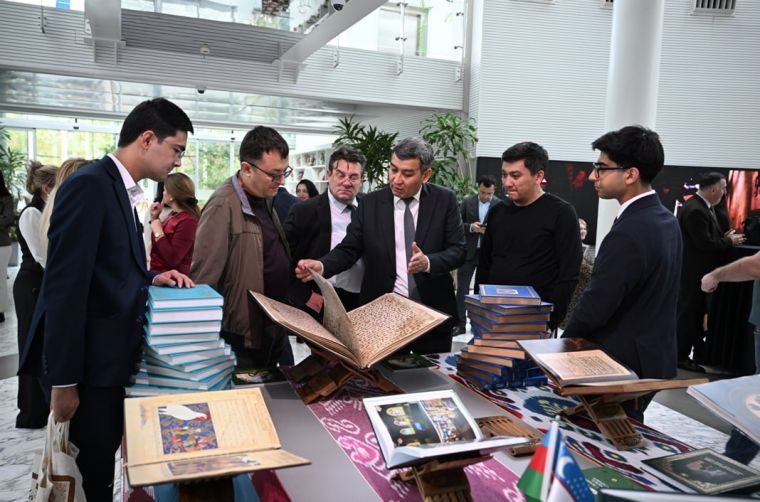
The famous ”Baburname” testifies to the history of the great Timurids, the struggle for the creation of a great power (the events of 1494-1529). The Institute of Oriental Studies of the Academy of Sciences of the Republic of Uzbekistan has more than 10 manuscript versions of “Baburname”. On the basis of which the Babur scholar Porso Shamsiev, having compared several manuscripts, published a critical text (1960) of a brilliant work. The text of “Baburname” was also published by N. Ilminsky (1847), Beverizh (1905), Fitrat (fragments, 1928) and P. Shamsiev (1960).
In 1521, the philosophical and religious work “Mubayin” was written, which outlines the 5 foundations of Islamic Sharia, and in the same year he wrote a book on taxation ”Mubayin-l-zakot”. His scientific works “Kharb Ishi” (“Military Affairs”), “Music of Ilmi” (“Science of Music”) have not yet been found.
Babur, on the basis of Arabic graphics, compiled “Khatti Boburiy” (“Babur’s Letter”), suitable for Turkic phonetics. This letter rewrote the Koran and individual works of Babur himself.
He was also engaged in literary translation, in verse he translated the religious and philosophical work “Volidia”(“Parental Treatise”) by the greatest master of Sufism – Khoja Ahror Vali, a follower of Bahautdin Nakshbandi.
Members of the international scientific expedition to study Babur’s work organized several scientific trips in the poet’s “footprints”, discovered more than 500 books and documents that are stored in the memorial museum “Babur and his place in the civilizational world”. In Andijan, there is Babur Park, where there is a symbolic grave, as well as the Ark Ichi memorial complex.
Babur was one of the greatest men of his time. Creating one of the most powerful empires in the history of the East, he, nevertheless, remained an ardent patriot of his country at heart and the rest of his life tried to establish diplomatic and friendly ties with his native city of Andijan.
We are generation of Zahiriddin Muhammad Babur.
Used Internet sites
1. advantour.com
2. uzbekistan.travel
3. turkestantravel.com
4. sputniknews.uz
5. ziyouz.uz
Prepared senior teacher of "Languages" department
of Tashkent Islamic institute named after Imam al-Bukhari



 Iman
 Prayer
 Fasting
 Zakat
 Haj
 Qur`an
 Lessons of Islam
 Contact