The Muslim World League
The Muslim World League (MWL) is an independent international organization comprising members from various Islamic countries and sects. Headquartered in Makkah, its mission is to clarify the true image of Islam and foster friendship among peoples.
Establishment:
The MWL was established by a resolution issued by the General Islamic Conference held in Makkah on May 18, 1962 (corresponding to 14 Dhu al-Hijjah 1381 AH).
The MWL Serves as a Member in:
- United Nations (UN): The MWL serves as an observer member in the Economic and Social Council, among international non-governmental organizations holding consultative status.
- Organization of Islamic Cooperation (OIC): The MWL serves as an observer, participating in summit conferences, meetings of foreign ministers, and all other conferences convened by the organization.
- United Nations Educational, Scientific and Cultural Organization (UNESCO): The MWL serves as a member.
- United Nations Children’s Fund (UNICEF): The MWL serves as a member.
Its Charter:
We, the members of the Muslim World League, representing the MWL with faith and conviction, pledge to Almighty Allah to:
- Call upon all nations to work toward achieving the happiness and welfare of humanity, ensuring social justice for all, and fostering the best possible human society.
- Bear witness before Allah that we do not seek to harm or interfere in the affairs of others, nor do we desire to dominate or exert control over anyone.
- Strive to unify Muslims and eliminate the causes of division within Islamic societies across the world.
- Promote and encourage all forms of benevolence.
- Declare that Islam does not endorse populism or racism.
- Unite our efforts to achieve these goals in a constructive and principled manner.
- Utilize all available spiritual, material, and moral means to fulfill the aspirations outlined in this charter.
The MWL’s Objectives and Methods of Implementation:
The MWL pursues its goals through means that fully comply with Islamic law, including the following:
- Introduce Islam and its tolerant values as presented in the Holy Qur’an and the Sunnah.
- Consolidate the principles of centrism and moderation within the consciousness of the Muslim Ummah.
- Address and resolve issues facing the Muslim Ummah and prevent factors that cause conflict and discord.
- Emphasize civilizational rapprochement and promote a culture of dialogue.
- Address the concerns of Muslim minorities and resolve their issues in accordance with the constitutions and legal frameworks of the countries in which they reside.
- Utilize the Hajj season as an opportunity to facilitate meetings among scholars, intellectuals, and organizational leaders to provide scientific and practical solutions for raising the standards of Muslims worldwide.
- Preserve the Islamic identity of the Ummah, strengthen its global standing, and enhance its unity.
Financial Management:
The Muslim World League relies on its endowments for financial management.
Investments derived from these endowments constitute a major source of funding for the organization.
The General Secretariat:
The General Secretariat of the Muslim World League serves as the executive arm of the organization. It oversees the day-to-day operations of the League and implements the policies and resolutions adopted by the Supreme Council. This is carried out under the leadership of the Secretary-General, with the support of assistant secretaries and the general administrative staff.
Headquarters:
Kingdom of Saudi Arabia
Makkah, Al-Aqaba District
P.O. Box 537
Tel: +966-12-5309444
Fax: +966-12-5601319 / +966-12-5601267
“Al-Ahram”: Uzbekistan emerges as a new center for the revival of Islamic Civilization
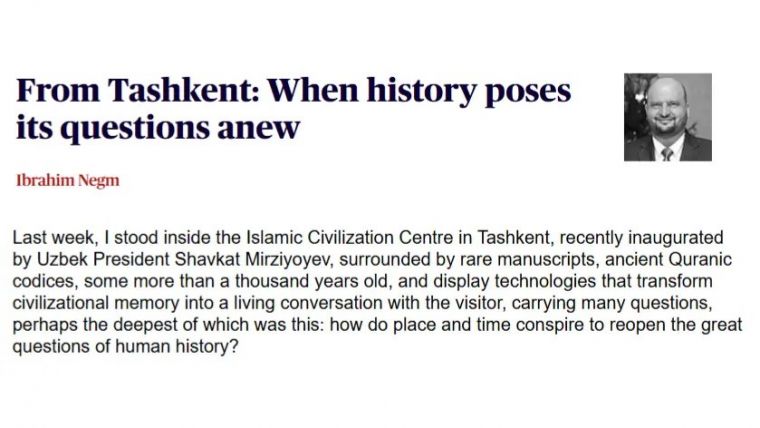
Egypt's largest daily newspaper “Al-Ahram” published an article by Ibrahim Negm, Senior Advisor to the Grand Mufti of Egypt, dedicated to his participation in the 1st International Forum of Islamic Civilization, which took place in Tashkent, Samarkand and Termez, reports Dunyo IA.
According to the author, the forum, held under the motto “The Path of Peace, tolerance and enlightenment”, exceeded all his expectations in terms of organization. Center of Islamic Civilization in Uzbekistan made a particularly profound and unforgettable impression on the scholar.
Article notes that the author was fascinated by the unique manuscripts, thousand-year-old copies of the Quran, and modern exhibition technologies presented at the Center. In his opinion, the past here is not merely displayed to visitors - thanks to modern museum solutions, each exhibit seems to acquire a new life.
Recalling his years of study at Harvard University, Ibrahim Negm discusses the theory of the “clash of civilizations”. He notes that despite the interpretation of this concept, according to which Islam was viewed as the main rival of the West, he had always doubted its scientific validity. According to the author, the Islamic civilization has never been in a state of stagnation and has never lagged behind global development.
During his visit to Uzbekistan, Ibrahim Negm visited historical and modern sites of the country's cultural and spiritual heritage, including the Center of Islamic Civilization, the Imam al-Bukhari complex, the Hakim al-Termizi mausoleum, and other shrines of the Islamic world. Based on the results of the trip, he concluded that the Islamic civilization and its rich spiritual and scientific heritage continue to dynamically develop, entering a new stage of their historical development.
Author also emphasizes that the Mushaf of Uthman, kept at the Center of Islamic Civilization, is one of the most valuable written relics not only of Uzbekistan but of the entire Islamic world. According to him, this manuscript represents a crucial source for studying the history of preserving the text of the Holy Quran in the first centuries of Islam.
