When millions of Muslims turn toward the Kaaba in Mecca for prayer, few may realize that the sweeping gold calligraphy on its iconic black cloth, the Kiswa, bears the legacy of a single artist — Abdul Rahim Amin Bukhari.
A master calligrapher from Mecca, Abdul Rahim Amin Bukhari dedicated his life to adorning Islam’s holiest site with words of divine beauty. His name, though not widely known outside Saudi Arabia, lives on in gold thread, etched into the sacred fabric that veils the Kaaba.
Abdul Rahim Amin Bukhari was born in 1917 in Mecca — a city pulsing with spiritual rhythm and Islamic tradition. As a boy surrounded by centuries-old mosques and devotional art, Bukhari was drawn to Arabic calligraphy early in life. What began as a childhood passion grew into a lifelong vocation.
At just 15, he joined the Kiswah Factory, newly established in 1927 by King Abdulaziz. This factory, devoted to producing the Kaaba’s annual covering, became the cradle of his artistic journey. Bukhari trained under the best, learning the subtle curves and disciplined elegance of classical scripts.
By the 1930s, he had risen to become chief technician, and eventually deputy director by the 1960s. His path was defined not only by artistic talent, but by humility and devotion.
Every year, the Kiswa is renewed — a majestic cloth of black silk, embroidered with Qur’anic verses in gold and silver thread. Its creation is a sacred task, and for decades, Bukhari was the pen behind its powerful script.
Specializing in the Thuluth script — a flowing, monumental style favored for religious inscriptions — Bukhari laid out every curve and flourish of the divine text. His designs set the standard, and to this day, artisans use his original layouts when crafting the Kiswa’s golden band (known as the hizam). His was not merely a job; it was an offering.
More than a technician, he was the soul of the Kiswa’s design. The gold lettering that millions of pilgrims see and touch was once inked by his hand on tracing paper, then embroidered stitch by stitch by a team he led and trained.
A Historic Commission: The Kaaba Door of 1944
One of the defining moments in Bukhari’s career came in 1944, when King Abdulaziz ordered the creation of a new door for the Kaaba. The old door, weathered by time, was to be replaced with a gilded masterpiece — and it was Bukhari who was asked to inscribe it with sacred text.
His calligraphy, rendered in bold Thuluth script, graced the new door’s copper and silver panels. The shahada (Islamic testimony of faith), the names of God, and select Qur’anic verses adorned its surface. These inscriptions were engraved into the metal by artisans, preserving Bukhari’s artistry in gleaming permanence.
This door, installed in 1947, became a symbol not just of royal generosity, but of spiritual craftsmanship. It was the first of two Kaaba doors Bukhari worked on — the second being the current door installed in 1979, which also features his calligraphy.
The Man Behind the Script
Though quiet and devoted, Bukhari’s work earned him respect at the highest levels. He wrote verses for early Saudi flags in the 1930s, crafted inscriptions for ceremonial mosque curtains, and even lettered the Rawdah curtain in Medina. King Faisal recognized his service by having Bukhari’s name woven into the Kiswa itself — a singular honor that continues to this day.
Visitors to Mecca who gaze upon the Kaaba’s belt will find his name hidden in gold — Abdul Rahim Amin. It is a subtle yet profound tribute to the man who helped shape the visual identity of Islam’s holiest structure.
A Living Legacy in Silk and Gold
Even after his passing in the late 1990s, Abdul Rahim Amin Bukhari’s calligraphy remains alive, literally sewn into the Kaaba each year. His templates are still used for the Kiswa’s verses, his scripts guide modern artisans, and his legacy continues to bridge art and worship in the most sacred way imaginable.
In the world of Islamic calligraphy, Bukhari stands as a pillar — not only for his mastery of pen and ink, but for how his work sanctified space. Every Muslim who looks at the Kaaba is unknowingly reading the words he shaped. Every stitch of gold thread reflects his lifelong devotion to making divine words beautiful.

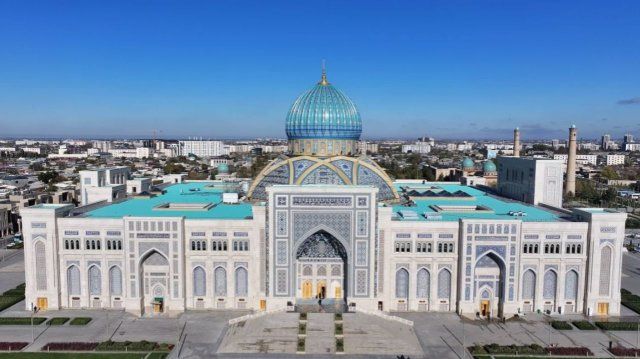
The Islamic Civilization Center in Uzbekistan has been receiving letters of appreciation and cooperation from leaders of foreign countries, prestigious international organizations, academic institutions, and participants of international conferences, further demonstrating the Center’s steadily growing reputation and influence on the global stage.
In particular, in a letter of appreciation addressed to Firdavs Abdukhalikov, Director of the Islamic Civilization Center in Uzbekistan, Her Majesty Raja Zarith Sofiah, Queen of Malaysia, expressed her sincere gratitude for the warm hospitality and cordial reception extended during her official visit to Uzbekistan. The Queen also emphasized that her visit to the Islamic Civilization Center in Uzbekistan left a lasting impression on her. She highly praised the Center’s exhibitions for their vivid and compelling presentation, through modern museum technologies, of the rich history and cultural heritage of Central Asia, as well as the scientific and spiritual legacy of the great scholars who made invaluable contributions to the development of Islamic civilization. In particular, she noted that the spiritual atmosphere of the Qur’an Hall and its unique heritage artifacts inspired in her profound respect and admiration.
The Islamic Civilization Center in Uzbekistan, along with the First International Islamic Civilization Forum held in Tashkent, Samarkand, and Termez from July 7 to 11, 2026, continues to receive widespread international recognition. Following the conclusion of the forum, numerous letters of appreciation and proposals for further cooperation were received from prominent international organizations, academic institutions, and public figures.
In his letter, Professor Shukran Abdul Rahman, Head of the Office of Strategic Institution Transformation at the International Islamic University Malaysia (IIUM), emphasized the international significance of the First International Islamic Civilization Forum. According to him, the forum, which brought together scholars, statesmen, and representatives of international organizations from more than 40 countries, played an important role in promoting the values of peace, tolerance, and enlightenment embodied in Islamic civilization, as well as in strengthening scientific dialogue and academic cooperation among nations. He also commended the high level of organization of the forum, the excellent conditions provided for participants, and the dignified presentation of Uzbekistan’s rich scientific and spiritual heritage to the international community.
The Forum and the activities of the Islamic Civilization Center in Uzbekistan were also highly praised in two separate letters sent by Russia’s Strategic Vision Group “Russia – Islamic World.” In particular, the letters described the establishment of the Islamic Civilization Center in Uzbekistan as one of the largest humanitarian and cultural-educational projects in the Islamic world of the twenty-first century. They also highlighted the leading role of President Shavkat Mirziyoyev in implementing this initiative and acknowledged his efforts to develop the Center into a hub of science, peace, enlightenment, humanism, and creativity.
At the same time, confidence was expressed that the Center would become a prestigious academic and educational institution for scholars, researchers, and students from around the world in the future. The letters also conveyed readiness to implement joint scientific and cultural projects in the fields of museology, history, archaeology, education, bibliography, and publishing.
In his letter, Professor Nidal Al-Ahmad, Secretary General of the Ministry of Culture of the Hashemite Kingdom of Jordan, also emphasized that the First International Islamic Civilization Forum was organized at the highest level, noting that the event once again demonstrated to the international community the tremendous contribution of Islamic civilization to the progress of humanity. He further highlighted that the forum, which brought together scholars, statesmen, and religious leaders from various countries, had become an important international platform for dialogue promoting the values of peace, tolerance, and enlightenment.
As another practical manifestation of the high level of international confidence in the Center’s activities, the regional office of ICESCO in Baku extended an official invitation to the Center’s leadership to participate in the Global Foresight Focal Points Initiative international event, held on July 27–28, 2026. The invitation emphasized the importance of expanding cooperation among ICESCO member states in the fields of strategic foresight, the introduction of innovative approaches to public administration, and future planning.
These expressions of recognition from foreign leaders, distinguished scholars, and international organizations once again confirm that the Islamic Civilization Center in Uzbekistan has, within a short period of time, become one of the leading platforms for international academic and educational cooperation. They also serve as clear evidence that the Center’s efforts to study, preserve, and promote the rich scientific and cultural heritage of Islamic civilization to the global community are receiving high international acclaim.