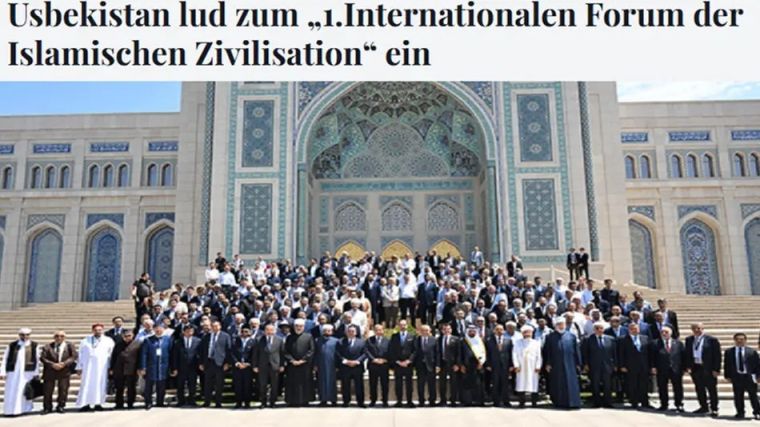
Popular German online publication “Hauptstadtecho” published an article dedicated to the first International Forum of Islamic Civilization “The Path of peace, tolerance and enlightenment” held in Uzbekistan, as well as the appeal of its participants to the President of Uzbekistan Shavkat Mirziyoyev, reports Dunyo IA.
Publication notes that the forum participants particularly emphasized the significance of the work carried out on the initiative of the Head of State to study, preserve and internationally popularize the rich scientific, spiritual and cultural heritage of the Islamic civilization.
In their Appeal, nearly 300 representatives from more than 50 countries - heads of authoritative international organizations, foreign scientific and educational institutions, ministers, muftis, prominent scholars, as well as representatives of universities, research institutes, libraries, museums and cultural centers - expressed their deep respect and sincere appreciation to the President of Uzbekistan.
Forum participants emphasized that the forum, organized on the initiative of the Head of State, went far beyond the scope of a traditional scientific conference in its content, international significance and prospective impact, becoming an important stage in the development of global scientific and humanitarian cooperation.
It is noted that the ideas and principles set forth in the address of President Shavkat Mirziyoyev to the forum participants defined the agenda of the event and created a solid spiritual and intellectual foundation for a meaningful dialogue and effective international scientific interaction.
Appeal particularly emphasizes that holding the forum in Tashkent, Samarkand, and Termez lent it a special historical and scientific significance. It was on this land that theology, philosophy, medicine, mathematics, astronomy and other sciences flourished for centuries, and outstanding thinkers and scholars made an invaluable contribution to the development of world civilization.
Forum participants also noted the initiative of the President of Uzbekistan, put forward in 2017 at the 72nd session of the UN General Assembly, to establish the Center of Islamic Civilization, calling it one of the most significant international humanitarian initiatives of the past decade.
In their opinion, the implementation of this initiative has opened up new opportunities for the objective study and wide dissemination of the Islamic civilization's contribution to the development of world science, culture and spirituality.
It is noted that the Center of Islamic Civilization in Uzbekistan is becoming not only a world-class scientific and educational institution but also a global intellectual platform uniting states, international organizations, scholars, universities, research institutes, museums and libraries. The participants expressed confidence that in the future, Center will take a worthy place among the leading international humanitarian institutions.
In conclusion, the appeal expressed confidence that the decisions made on the ancient land of Uzbekistan will contribute to strengthening peace, enlightenment, mutual respect, and cooperation between peoples, as well as preserving and passing on to future generations the great spiritual and intellectual heritage of the Islamic civilization.



 Iman
Iman  Prayer
  Fasting
  Zakat
Zakat  Haj
Haj  Qur`an
  Lessons of Islam
  Contact