The site is working in test mode!
19 August, 2026   |   6 Rabī‘ al-awwal, 1448

Tashkent city
Fajr
04:09
Sunrise
05:36
Dhuhr
12:27
Asr
17:16
Maghrib
19:21
Isha
20:43
Bismillah
19 August, 2026, 6 Rabī‘ al-awwal, 1448

Gandhi Praised Caliphs Abu Bakar and Umar as Role Models in His 1937 Newspaper

28.10.2025   117435   2 min.
Gandhi Praised Caliphs Abu Bakar and Umar as Role Models in His 1937 Newspaper

In the July 27, 1937 issue of his weekly journal Harijan, Mahatma Gandhi praised Islamic Caliphs Abu Bakar (RA) and Umar Farooq (RA) as examples of humble and responsible leadership.

In a rare reference to Islamic history, Mahatma Gandhi praised Caliphs Abu Bakar and Umar Farooq as examples of simple and honest leadership.

He made this statement in the July 27, 1937 issue of his weekly journal, Harijan, offering advice to Indian National Congress leaders as they began to hold public office.

In that issue of Harijan, Gandhi wrote:

“I cannot give you the reference of Ram Chandar or Krishna, because they were not considered as historical figures. I cannot help it but to present to you the names of (Hazrat) Abu Bakar (RA) and (Hazrat) Umar Farooq (RA). They were leaders of a vast Empire, yet they lived a life of austerity.” Harijan – Dated: 27.07.1937

This statement came during an important moment in India’s history. In 1937, the Indian National Congress formed governments in several provinces for the first time under British rule, following elections held under the Government of India Act, 1935.

Gandhi, always cautious about the moral health of leaders, urged Congress members not to be consumed by power or luxury. He used the examples of Caliphs Abu Bakar and Umar Farooq to remind them that true leaders live simply and serve the people.

Harijan was Gandhi’s weekly newspaper, launched in 1933 to support his social reform campaigns — especially against untouchability. The journal regularly featured Gandhi’s views on religion, politics, and ethics.

The journal was published in English, along with versions in Hindi (Harijan Sewak) and Gujarati (Harijanbandhu), and ran until 1955.

This was not the only time Gandhi showed appreciation for Islamic values. He often quoted the Quran, Prophet Muhammad (PBUH), and his companions in speeches and writings.


Gandhi Praised Caliphs Abu Bakar and Umar as Role Models in His 1937 Newspaper
Other posts

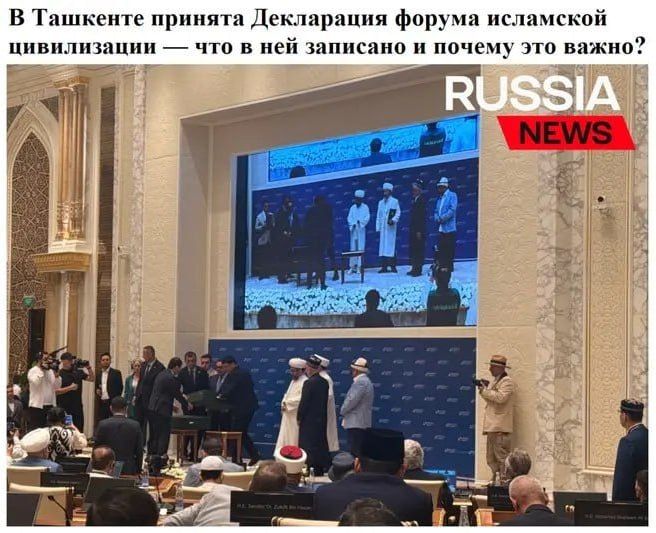
“Russia News”: Final Declaration of the Forum adopted in Tashkent will serve to restore the Heritage of Islamic Civilization

16.07.2026   58892   2 min.
 “Russia News”: Final Declaration of the Forum adopted in Tashkent will serve to restore the Heritage of Islamic Civilization

Russian online publication “Russia News” has published an article titled “Declaration of the Islamic Civilization Forum adopted in Tashkent - What is written in it and why is it important?”, reports Dunyo IA.

Publication states that following the 1st International Forum of Islamic Civilization “The Path of Peace, tolerance and enlightenment”, a Declaration was adopted, which outlines a number of concrete initiatives for the revival and promotion of the humanistic heritage of Islamic civilization.

It is noted that the starting point of the Declaration is the initiative of the President of Uzbekistan, Shavkat Mirziyoyev, voiced back in 2017 from the rostrum of the UN General Assembly. At that time, he proposed to engage in the revival and promotion of the humanistic heritage of Islamic civilization. This resulted in the creation of the Center of Islamic Civilization in Uzbekistan and ultimately, the forum itself.

Document was signed by representatives from more than 40 countries. At its core is a simple but important idea: Islamic civilization has made a tremendous contribution to global science, culture, and education, and this contribution is undeservedly underestimated. This is especially true against the backdrop of the fact that Islamophobia, xenophobia and simply distorted perceptions of Islam remain prevalent in the world.

Publication also notes a number of initiatives aimed at preserving and popularizing the Islamic civilizational heritage. Among them are the creation of the World Alliance of Islamic Civilization, digital platforms and libraries, international research programs, awards, funds, an encyclopaedia, as well as platforms for cooperation among scholars, museums, and youth. All proposals have been submitted to the International Council of the Forum for the development of a roadmap for their implementation until 2030.

In conclusion, the publication notes that the Declaration is viewed not as a finality, but as a starting point for further implementation.