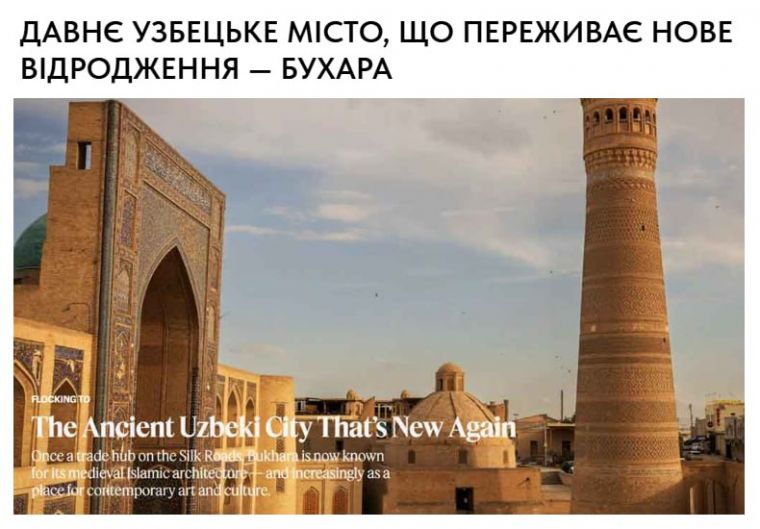
Today ancient Bukhara is once again strengthening its position as an international cultural centre and experiencing a new stage of cultural and tourism development, reports Dunyo IA correspondent, citing with reference to the Ukrainian magazine “Kyiv Diplomatic”.
Publication notes that the American newspaper “The New York Times” published an article dedicated to Bukhara, one of the oldest cities in Uzbekistan. For more than a thousand years, Bukhara remained one of the most important centres of the Great Silk Road, connecting the East and the West. Trade routes passed through the city, along which jewellery, textiles, porcelain, and other valuable goods were transported. From the 8th to the 13th centuries, Bukhara became one of the largest intellectual and cultural centres of the Islamic world, where outstanding scholars, architects, mathematicians and artists worked.
Authors of the publication pay particular attention to the city’s rich historical and architectural heritage. Bukhara has preserved the ancient Ark Fortress, mausoleums, madrasas, mosques with distinctive turquoise domes, and other landmarks, many of which are included in the UNESCO World Heritage List. More than 140 sites of the historic center are located within walking distance of one another, making the city one of the best-preserved historical complexes in Central Asia.
According to the publication, today Bukhara is once again strengthening its position as an international cultural center. One of the most important events was the first Bukhara Biennial of Contemporary Art, held in the autumn of last year. As part of the project, artists from Uzbekistan and other countries created works specifically for the city’s historic spaces, collaborated with local artisans and participated in joint cultural initiatives.
As noted in the publication, the organization of the Biennial contributed not only to the promotion of cultural heritage but also to the development of tourism infrastructure. New hotels, restaurants, cultural spaces and shops are opening in Bukhara, catering to the growing interest of international travellers.
“The New York Times” also presented its own city guide, recommending that tourists visit historical landmarks, including the Sitorai Mokhi-Khosa Palace, Chor-Bakr Memorial Complex, Baland Mosque and Khoja Zayniddin Sufi Complex.



 Iman
Iman  Prayer
  Fasting
  Zakat
Zakat  Haj
Haj  Qur`an
  Lessons of Islam
  Contact