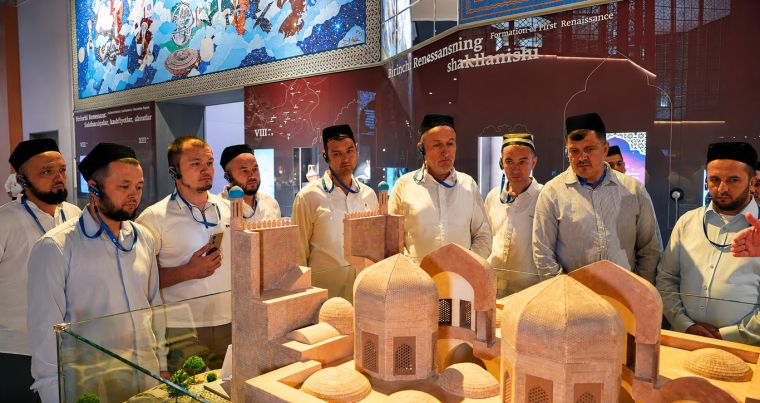
Uzbekistan is taking confident steps to connect its rich spiritual and cultural heritage with the global academic community by expanding international scientific cooperation, reports iccu.uz.
As a tangible reflection of this effort, the Islamic Civilization Center in Uzbekistan hosted a ceremony to receive 1,000 rare books for its library. The collection was presented by Dr. Muhammad Zakariya Al-Orabi, Head of the Orabi International Group in the Sultanate of Oman and a distinguished researcher and public figure.
The event was attended by representatives of the Committee on Religious Affairs, the leadership of the Islamic Civilization Center in Uzbekistan, scholars, researchers, and leading experts in the field.
During the ceremony, Gulnora Ganieva, Deputy Director of the Center, emphasized that under the leadership of President Shavkat Mirziyoyev, the development of science, the preservation of cultural heritage, the study of manuscripts, and the acquisition of rare sources preserved in countries around the world have been elevated to the level of state policy.
She noted that the Islamic Civilization Center in Uzbekistan, established at the initiative of the President, has evolved into far more than a museum or a library. Today, it serves as an international platform for scholarly dialogue on the history of Islamic civilization, source studies, and Oriental studies.
“The books presented by the Sultanate of Oman will do far more than enrich our library’s collection. They will serve as a solid foundation for expanding fundamental research in the history of Islamic civilization, Islamic law, Qur’anic exegesis, Hadith studies, Islamic creed, the Arabic language, and many other disciplines. They will also contribute to the education and development of a new generation of scholars,” said Gulnora Ganieva.
Dr. Muhammad Zakariya Al-Orabi described the presentation of the books as a symbolic milestone in the cultural and academic cooperation between the two countries.
“These are not merely books. They represent respect for knowledge, a commitment to enlightenment, and an intellectual bridge that strengthens trust between our peoples. We highly appreciate President Shavkat Mirziyoyev’s initiative to establish the Islamic Civilization Center in Uzbekistan. We are confident that this Center will become a distinguished platform uniting the scholarly heritage of the entire Islamic world,” said Dr. Al-Orabi.
According to him, libraries preserve the collective memory of human civilization, and every book opens the door to new knowledge, fresh ideas, and groundbreaking scholarly discoveries. Therefore, investing in knowledge is equivalent to investing in the future.
Davronbek Maqsudov, First Deputy Chairman of the Committee on Religious Affairs, who also attended the ceremony, underscored the significance of this noble initiative for strengthening the country’s academic and research potential.
He noted that bringing fundamental scholarly publications published in the Arab world in recent years to Uzbekistan will expand the pool of reliable academic resources available to researchers, university faculty, master’s students, and young scholars.
The donated collection covers a wide range of disciplines, including Islamic history, Qur’anic exegesis, Hadith studies, Islamic jurisprudence, Islamic creed, the Arabic language, the history of Islamic civilization, and other fields. It also includes recently published academic works from across the Arab world, further strengthening the Center’s Library as one of the region’s richest specialized collections.
In recent years, Uzbekistan has pursued an active foreign policy in the field of cultural diplomacy. At the initiative of President Shavkat Mirziyoyev, international cooperation has expanded through the Islamic Civilization Center in Uzbekistan, the International Islamic Academy of Uzbekistan, and the Imam Bukhari, Imam Termizi, and Imam Maturidi International Scientific Research Centers. Joint projects are being implemented in partnership with UNESCO, ICESCO, and a number of leading academic institutions.
The donation of 1,000 rare books from the Sultanate of Oman is regarded as another tangible outcome of this consistent state policy.
At the conclusion of the ceremony, both sides emphasized that this meaningful initiative would further strengthen academic, cultural, and educational cooperation between Uzbekistan and the Sultanate of Oman. They also expressed their readiness to expand collaboration through joint research projects, book exchange programs, scholarly expeditions, and academic initiatives.



 Iman
Iman  Prayer
  Fasting
  Zakat
Zakat  Haj
Haj  Qur`an
  Lessons of Islam
  Contact