Center for Islamic Civilization presented in Beijing

A cultural, educational and media event titled “Uzbekistan - China: Dialogue of Civilizations and Shared Heritage” has been held at the Embassy of our country, reports Dunyo IA.
Event was attended by the leadership of the SCO Secretariat, representatives of the diplomatic corps in Beijing, ministries and agencies, leading think tanks, scientific, academic and cultural circles, as well as Chinese media.
Delegation of Uzbekistan, led by Firdavs Abdukhalikov, Director of the Center for Islamic Civilization, participated in the forum.
A comprehensive presentation on the activities of the Center for Islamic Civilization was delivered to the participants, highlighting its unique concept, key expositions, scientific and educational dimensions, as well as its international mission to study, preserve, and popularize the rich heritage of our people. The event also featured the screening of a documentary film on the operations of the Center for Islamic Civilization.
An exposition of over 100 video and photo works reflecting the rich history, culture and modern development of Uzbekistan was also organized for the attention of the participants. The exposition was harmoniously complemented by an exhibition of applied arts and craftsmanship.
Participants expressed a unanimous opinion that the Center for Islamic Civilization, established on the initiative and under the authorship of the President of Uzbekistan, is a spiritual and cultural masterpiece of global significance. The creation of such a unique Center, which has no analogues in the world, reflects the Leader of the country's profound dedication to the history and cultural heritage of his people, and clearly demonstrates the high place of Uzbekistan at the crossroads of civilizations.
As part of the event, permanent expositions were set up within the Embassy building, including a book exhibition dedicated to the history and rich cultural heritage of Uzbekistan, as well as a photo exhibition of the Center for Islamic Civilization.
SCO Deputy Secretary-General Janesh Kain:
- Today, we have been presented with a unique opportunity to become living witnesses to a historic event – the presentation of the majestic building of the Center for Islamic Civilization constructed in Tashkent, which has already acquired global and worldwide significance.
Realization of this cherished goal of the esteemed President of Uzbekistan, Shavkat Mirziyoyev, has demonstrated to the entire world the essence and vision behind building the New Uzbekistan, which embodies the spirit of great civilizations.
Uzbekistan has always been a center of education. Great minds of humanity lived and created their works here. Today, we are witnessing the revival of history through this Center, which will play an important role in disseminating information to the world about the wisdom of the Uzbek people.
Han Hua, Co-Founder and Secretary-General of the Beijing Club for International Dialogue:
- Uzbekistan is one of the important centers of world culture and art. In the New Uzbekistan, this manifests itself with particular clarity, thanks to the wise policy of President Shavkat Mirziyoyev, who, with profound dedication, glorifies to the entire world the rich cultural and spiritual heritage of not only his country but the entire Eastern civilization. Representatives of the Uzbek people have made a powerful contribution to the development of world science and enlightenment.
Country is implementing historic reforms recognized by the global community. The Center for Islamic Civilization strengthens the spiritual foundations of society and this stands as one of the key parameters of Uzbekistan's development.

“EM Insights”: Media Forum in Tashkent calls on the Media to preserve cultural memory
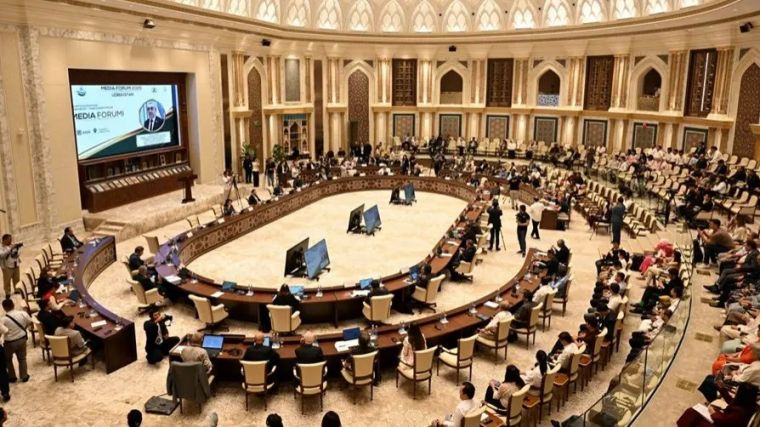
International Media Forum, organized by the Center for Islamic Civilization in Uzbekistan, brought together representatives of nearly 300 media outlets from 50 countries, reports Dunyo IA correspondent, citing with the British portal “EM Insights”.
Participants discussed the impact of digital platforms and artificial intelligence on journalism, as well as the promotion of the historical and intellectual heritage of Islamic civilization.
Mohammad Osman, Managing Editor of The Peninsula newspaper, described the forum as “timely and vital”, emphasizing the importance of fact-checking and a responsible approach to information.
Editor of the National Information Agency of Uzbekistan Utkir Alimov noted the country’s growing role as a “crossroads of civilizations” and called for the development of international media projects and professional exchanges. Forum was organized by the Center for Islamic Civilization in Uzbekistan. Participants discussed the impact of digital platforms, artificial intelligence and modern media formats on the dissemination of historical knowledge and the shaping of perceptions of Islamic civilization.
Mohammad Osman, Managing Editor of Qatar’s “The Peninsula” newspaper, described the forum as “timely and vital”. According to him, Imam al-Bukhari’s methods of verifying the authenticity of hadiths remain relevant in the digital age, when journalists face disinformation and AI-generated content.
Utkir Alimov, Editor of the National Information Agency of Uzbekistan (UzA), noted that the participation of representatives from nearly 300 media outlets across 50 countries demonstrates the growing role of Uzbekistan as a "crossroads of civilizations.
“In an era of instantaneous news dissemination, journalism must do more than just inform. It is called upon to preserve and transmit our shared cultural memory”, he stated.
Necessity of developing international cooperation, joint media projects, documentary films and professional exchanges to popularize the historical and intellectual heritage of Central Asia was also emphasized.
- «
- »