News
ICESCO Publishes Landmark Scientific Study on Imam al-Bukhari’s “Al-Jami‘ al-Sahih” with Contributions from Scholars in 16 Countries
30.07.2026
53181
2 min.
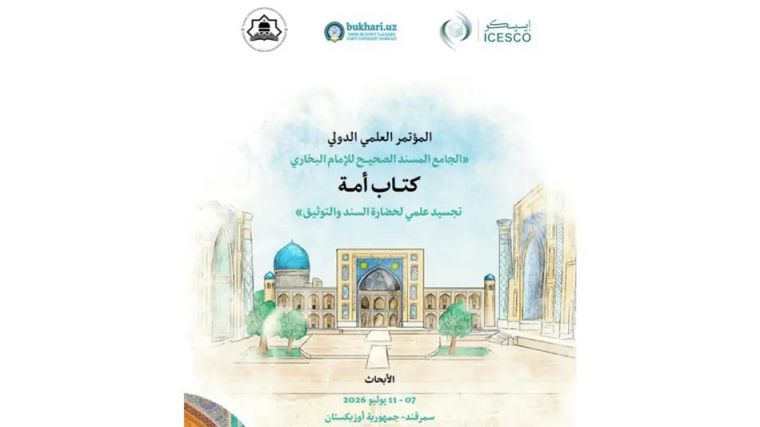
The Islamic World Educational, Scientific and Cultural Organization (ICESCO) has presented a new landmark scholarly publication titled “Al-Jami‘ al-Musnad al-Sahih of Imam al-Bukhari: The Book of the Ummah. A Scientific Representation of the Civilization of Isnād and Hadith Authentication,” reports Dunyo IA.
Leading scholars and researchers from 16 countries contributed to the preparation of the publication.
The book is the result of the International Scientific Conference “Imam al-Bukhari’s Work ‘Al-Jami‘ al-Sahih’ – The Book of the Ummah,” held on July 9–10, 2026, in Samarkand. The international scientific and practical conference was organized by the Center of Islamic Civilization of Uzbekistan, the Imam al-Bukhari International Research Center, and ICESCO.
The new publication, comprising nearly 800 pages, represents one of the most extensive modern studies dedicated to the scholarly legacy of the great Islamic scholar Imam al-Bukhari. It includes academic articles covering contemporary research in hadith studies, the history of Islamic scholarship, and methods of verifying the authenticity of hadiths.
The book focuses on five major thematic areas: the historical and scholarly environment in which Imam al-Bukhari lived and worked; his unique methodology for selecting and classifying hadiths; rare manuscripts of Sahih al-Bukhari preserved in libraries around the world; the contributions of scholars from different eras to the study and dissemination of this significant work; and modern academic discussions surrounding Sahih al-Bukhari, including well-founded responses to existing critiques.
The publication marks an important contribution to international cooperation in the field of Islamic studies and highlights Uzbekistan’s growing role as one of the world’s leading centers for research into the rich spiritual and scholarly heritage of Imam al-Bukhari.
The book also contributes to the preservation and promotion of Islamic scientific heritage among researchers, students, and a wide global audience.
SHARE INFORMATION ON SOCIAL NETWORKS



 Iman
Iman  Prayer
  Fasting
  Zakat
Zakat  Haj
Haj  Qur`an
  Lessons of Islam
  Contact