“The Diplomatic Insight”: Uzbekistan combines its historical heritage with modern development
16.09.2026
128997
1 min.
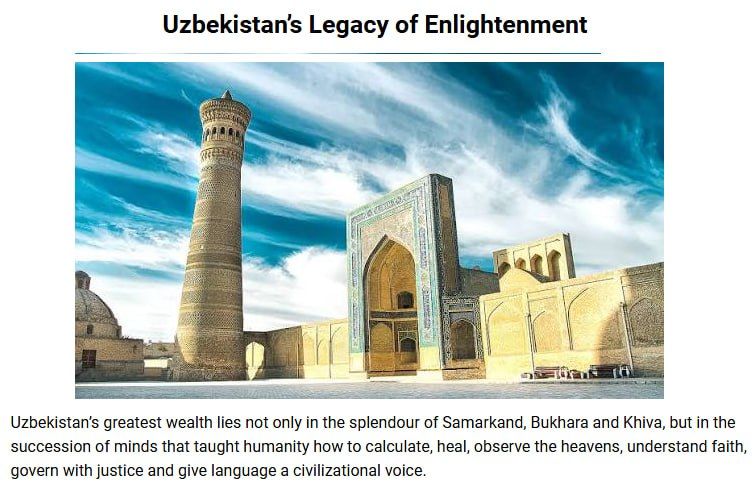
Popular Pakistani portal “The Diplomatic Insight” has published an article by Muhammad Asif Noor, Executive Director of the Institute of Peace and Diplomatic Studies, on Uzbekistan’s enlightenment heritage, reports Dunyo IA.
Author notes that the country is seeking to link its rich historical heritage with modern development. In his assessment, museums, research centers, specialized schools and cultural diplomacy are becoming part of the policy aimed at laying the foundations for the Third Renaissance.
Article also highlights the role of Samarkand, Bukhara and Khiva, as well as the heritage of Amir Temur and the Temurids. Particular attention is paid to the development of the Center for Islamic Civilization and the Imam Bukhari complex, which, as noted, bring together the preservation of historical memory, education and scientific research.
Author also emphasizes the international significance of Uzbekistan’s cultural traditions, including Shashmaqom, Lazgi, Askiya and the art of bakhshi, many of which have been recognized by UNESCO.
SHARE INFORMATION ON SOCIAL NETWORKS



 Iman
 Prayer
 Fasting
 Zakat
 Haj
 Qur`an
 Lessons of Islam
 Contact