Much efforts are being done to deliver the true and pure essense of Islam in our country. One of such actions was done in Pskent district last year when Usmankhan Alimov, the Chairman of Muslim Board of Uzbekistan and Khayrulla Turmatov, Chief Imam of Tashkent region put initial bricks to build the mosque “Usmat Ota”.
The capacity of the newly built mosque is 250-300 people and in the nearest future the construction of library, museum and parking lot are expected to be raised in an adjoining area.
In his speech Muftiy Usmonkhon Alimov congratulated muslims with this historical event. Later the guests were invited for a lunch organized by Akromov, District Mayor.
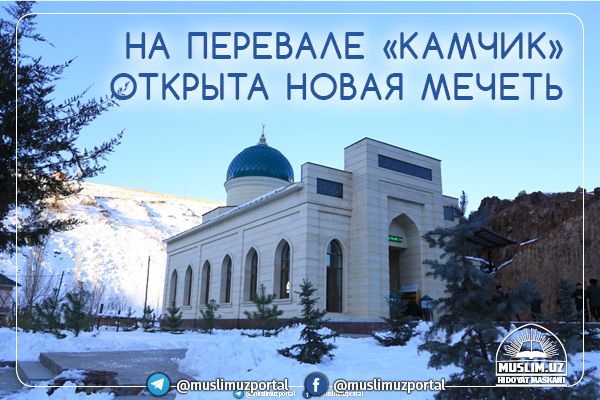
Another new mosque has been opened in Kuksaroy neighborhood, Okhangaron district, Tashkent region. The mosque “Islom nuri (Light of Islam)” is located just on the side of the highway of Kamchik mountain highway pass.
The opening ceremony was led by Muftiy Usmankhan Alimov, who in his speech expressed warm wishes to worshippers and made genuine prayers.
{gallery}//2018/01.01.2018/Islom_nuri{/gallery}
Press Service,
Muslim Board of Uzbekistan
When millions of Muslims turn toward the Kaaba in Mecca for prayer, few may realize that the sweeping gold calligraphy on its iconic black cloth, the Kiswa, bears the legacy of a single artist — Abdul Rahim Amin Bukhari.
A master calligrapher from Mecca, Abdul Rahim Amin Bukhari dedicated his life to adorning Islam’s holiest site with words of divine beauty. His name, though not widely known outside Saudi Arabia, lives on in gold thread, etched into the sacred fabric that veils the Kaaba.
Abdul Rahim Amin Bukhari was born in 1917 in Mecca — a city pulsing with spiritual rhythm and Islamic tradition. As a boy surrounded by centuries-old mosques and devotional art, Bukhari was drawn to Arabic calligraphy early in life. What began as a childhood passion grew into a lifelong vocation.
At just 15, he joined the Kiswah Factory, newly established in 1927 by King Abdulaziz. This factory, devoted to producing the Kaaba’s annual covering, became the cradle of his artistic journey. Bukhari trained under the best, learning the subtle curves and disciplined elegance of classical scripts.
By the 1930s, he had risen to become chief technician, and eventually deputy director by the 1960s. His path was defined not only by artistic talent, but by humility and devotion.
Every year, the Kiswa is renewed — a majestic cloth of black silk, embroidered with Qur’anic verses in gold and silver thread. Its creation is a sacred task, and for decades, Bukhari was the pen behind its powerful script.
Specializing in the Thuluth script — a flowing, monumental style favored for religious inscriptions — Bukhari laid out every curve and flourish of the divine text. His designs set the standard, and to this day, artisans use his original layouts when crafting the Kiswa’s golden band (known as the hizam). His was not merely a job; it was an offering.
More than a technician, he was the soul of the Kiswa’s design. The gold lettering that millions of pilgrims see and touch was once inked by his hand on tracing paper, then embroidered stitch by stitch by a team he led and trained.
A Historic Commission: The Kaaba Door of 1944
One of the defining moments in Bukhari’s career came in 1944, when King Abdulaziz ordered the creation of a new door for the Kaaba. The old door, weathered by time, was to be replaced with a gilded masterpiece — and it was Bukhari who was asked to inscribe it with sacred text.
His calligraphy, rendered in bold Thuluth script, graced the new door’s copper and silver panels. The shahada (Islamic testimony of faith), the names of God, and select Qur’anic verses adorned its surface. These inscriptions were engraved into the metal by artisans, preserving Bukhari’s artistry in gleaming permanence.
This door, installed in 1947, became a symbol not just of royal generosity, but of spiritual craftsmanship. It was the first of two Kaaba doors Bukhari worked on — the second being the current door installed in 1979, which also features his calligraphy.
The Man Behind the Script
Though quiet and devoted, Bukhari’s work earned him respect at the highest levels. He wrote verses for early Saudi flags in the 1930s, crafted inscriptions for ceremonial mosque curtains, and even lettered the Rawdah curtain in Medina. King Faisal recognized his service by having Bukhari’s name woven into the Kiswa itself — a singular honor that continues to this day.
Visitors to Mecca who gaze upon the Kaaba’s belt will find his name hidden in gold — Abdul Rahim Amin. It is a subtle yet profound tribute to the man who helped shape the visual identity of Islam’s holiest structure.
A Living Legacy in Silk and Gold
Even after his passing in the late 1990s, Abdul Rahim Amin Bukhari’s calligraphy remains alive, literally sewn into the Kaaba each year. His templates are still used for the Kiswa’s verses, his scripts guide modern artisans, and his legacy continues to bridge art and worship in the most sacred way imaginable.
In the world of Islamic calligraphy, Bukhari stands as a pillar — not only for his mastery of pen and ink, but for how his work sanctified space. Every Muslim who looks at the Kaaba is unknowingly reading the words he shaped. Every stitch of gold thread reflects his lifelong devotion to making divine words beautiful.