Jinnah Antarctic Research Station, operational since 1991, emerges as likely site of inaugural salah in Antarctica amid Pakistan’s polar scientific missions.
The Jinnah Antarctic Station, Pakistan’s permanent research facility established in 1991, is recognized as the first confirmed location where Islamic prayers (salah) were performed on the Antarctic continent.
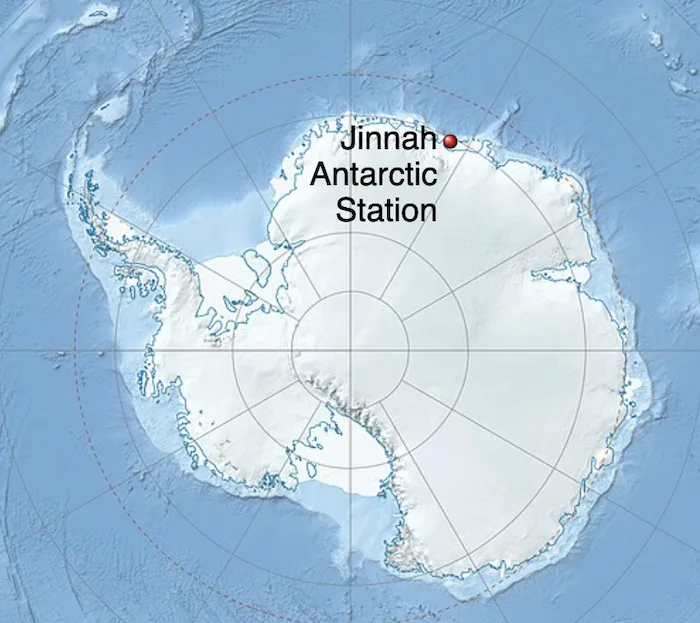
Situated in the East Antarctic region, the station has served as a scientific and logistical base for decades.
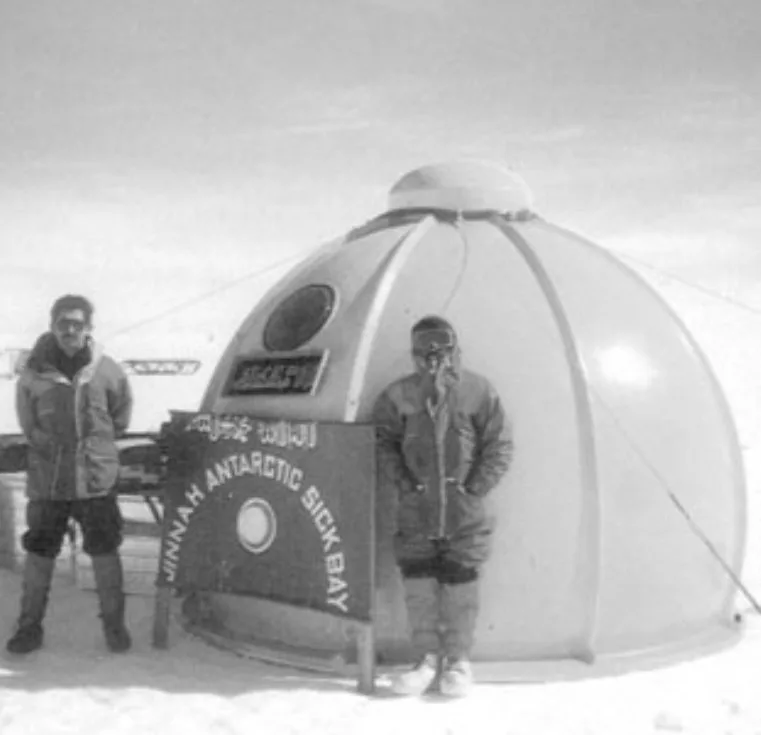
Operated by Pakistan’s National Institute of Oceanography, the station conducts year-round studies in glaciology, marine biology, and climate science.
Since its inauguration, Muslim members of winter-over teams have maintained prayer routines within designated spaces at the base, despite extreme cold, months-long darkness, and isolation.
While informal worship likely occurred earlier during transient expeditions, documented communal prayers began with the station’s continuous operation.
A small musallah (prayer area) was established inside the main living module, oriented toward Mecca using calculated qibla directions specific to the Antarctic region.
Antarctic Treaty protocols respect all forms of religious observance across research stations. The Government of Pakistan confirmed the station remains active today, with ongoing research and religious accommodation for personnel.
The station is named for Muhammad Ali Jinnah, founder of Pakistan.
The Islamic World Educational, Scientific and Cultural Organization (ICESCO) has presented a new landmark scholarly publication titled “Al-Jami‘ al-Musnad al-Sahih of Imam al-Bukhari: The Book of the Ummah. A Scientific Representation of the Civilization of Isnād and Hadith Authentication,” reports Dunyo IA.
Leading scholars and researchers from 16 countries contributed to the preparation of the publication.
The book is the result of the International Scientific Conference “Imam al-Bukhari’s Work ‘Al-Jami‘ al-Sahih’ – The Book of the Ummah,” held on July 9–10, 2026, in Samarkand. The international scientific and practical conference was organized by the Center of Islamic Civilization of Uzbekistan, the Imam al-Bukhari International Research Center, and ICESCO.
The new publication, comprising nearly 800 pages, represents one of the most extensive modern studies dedicated to the scholarly legacy of the great Islamic scholar Imam al-Bukhari. It includes academic articles covering contemporary research in hadith studies, the history of Islamic scholarship, and methods of verifying the authenticity of hadiths.
The book focuses on five major thematic areas: the historical and scholarly environment in which Imam al-Bukhari lived and worked; his unique methodology for selecting and classifying hadiths; rare manuscripts of Sahih al-Bukhari preserved in libraries around the world; the contributions of scholars from different eras to the study and dissemination of this significant work; and modern academic discussions surrounding Sahih al-Bukhari, including well-founded responses to existing critiques.
The publication marks an important contribution to international cooperation in the field of Islamic studies and highlights Uzbekistan’s growing role as one of the world’s leading centers for research into the rich spiritual and scholarly heritage of Imam al-Bukhari.
The book also contributes to the preservation and promotion of Islamic scientific heritage among researchers, students, and a wide global audience.