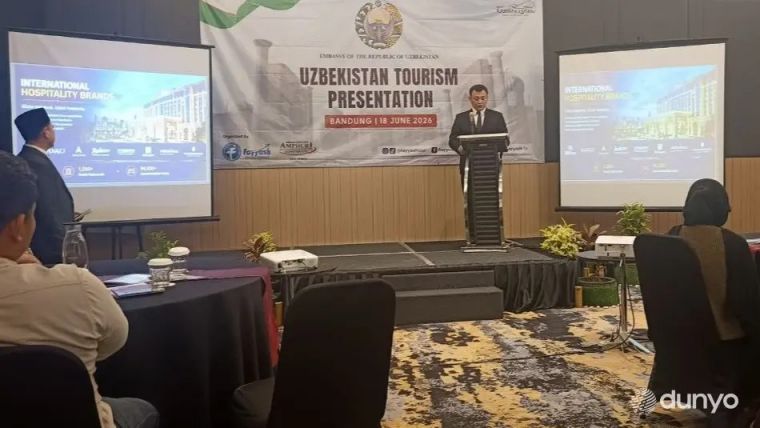
An event dedicated to the tourism potential of Uzbekistan was organized in Bandung, administrative center of West Java Province, reports Dunyo IA.
The event focused on extensively promoting the rich historical and cultural heritage, alongside the pilgrimage tourism opportunities of Uzbekistan, to the Indonesian public, while aiming to elevate bilateral tourism cooperation between the two nations to a fundamentally new level.
At the outset of the event, detailed insights were provided into the economic and demographic potential of West Java Province. With a population reaching approximately 51 million, this region stands as one of the largest and most economically advanced territories within Indonesia.
The province boasts a dynamic industrial landscape, characterized by the rapid development of the automotive, electronics, textile, chemical, logistics, and service sectors. Concurrently, West Java is widely recognized as a premier center for the Hajj and Umrah services market in Indonesia, driven by its predominantly Muslim population.
During the meeting, it was underscored that West Java is home to hundreds of licensed Hajj and Umrah tour operators, facilitating sacred journeys for hundreds of thousands of citizens annually, with the city of Bandung serving as a crucial religious and educational center. These overarching factors clearly demonstrate the vast, untapped potential for robust cooperation with Uzbekistan in the field of pilgrimage tourism.
The core segment of the event was dedicated to highlighting the paramount role of Uzbekistan's historic cities—Samarkand, Bukhara, Khiva and Termez - in Islamic civilization, showcasing the nation's sacred shrines, the rich heritage of great scholars, and the comprehensive institutional reforms executed in the tourism sector in recent years.
Concurrently, detailed information was provided regarding the modern tourism infrastructure, international standard hospitality networks, transport-logistics capacities, and the comprehensive facilities established for foreign guests.
Special video presentations highlighting the activities of the Center of Islamic Civilization in Uzbekistan and the Imam Al-Bukhari International Scientific Research Center were also showcased. The presentation generated immense interest among the participants.
Speaking at the event, the leadership of the West Java Hajj and Umrah Association emphasized the profound potential for expanding multifaceted cooperation with Uzbekistan. In their view, Uzbekistan stands as a pivotal cradle of Islamic civilization, and the sublime heritage of legendary scholars such as Imam Al-Bukhari, Imam Al-Tirmidhi and Bahauddin Naqshband carries immense spiritual and educational significance for the Indonesian Muslim community.
Furthermore, it was noted that the establishment of direct air connectivity between Jakarta and Tashkent will serve as a catalyst to elevate bilateral tourism cooperation to a fundamentally new level. Leading tour operators in West Java, including prominent agencies such as “DAGO Travel”, are expressing profound interest in the Uzbekistan market. Several operators highlighted their ongoing practice of facilitating travel for hundreds of Indonesian pilgrims to Uzbekistan annually.
The event participants emphasized that comprehensive tour packages encompassing historic cities such as Samarkand, Bukhara, and Termez hold exceptional appeal for Indonesian travellers.
At the conclusion of the event, the participants held detailed discussions on the procedures for traveling to Uzbekistan, visa regimes, air connectivity, hospitality infrastructure, and frameworks for close cooperation with local tour operators. This presentation served as a significant milestone in further expanding bilateral cooperation in the field of pilgrimage tourism, strengthening cultural and humanitarian ties, and driving a substantial increase in the influx of Indonesian tourists to the Republic.



 Iman
Iman  Prayer
  Fasting
  Zakat
Zakat  Haj
Haj  Qur`an
  Lessons of Islam
  Contact